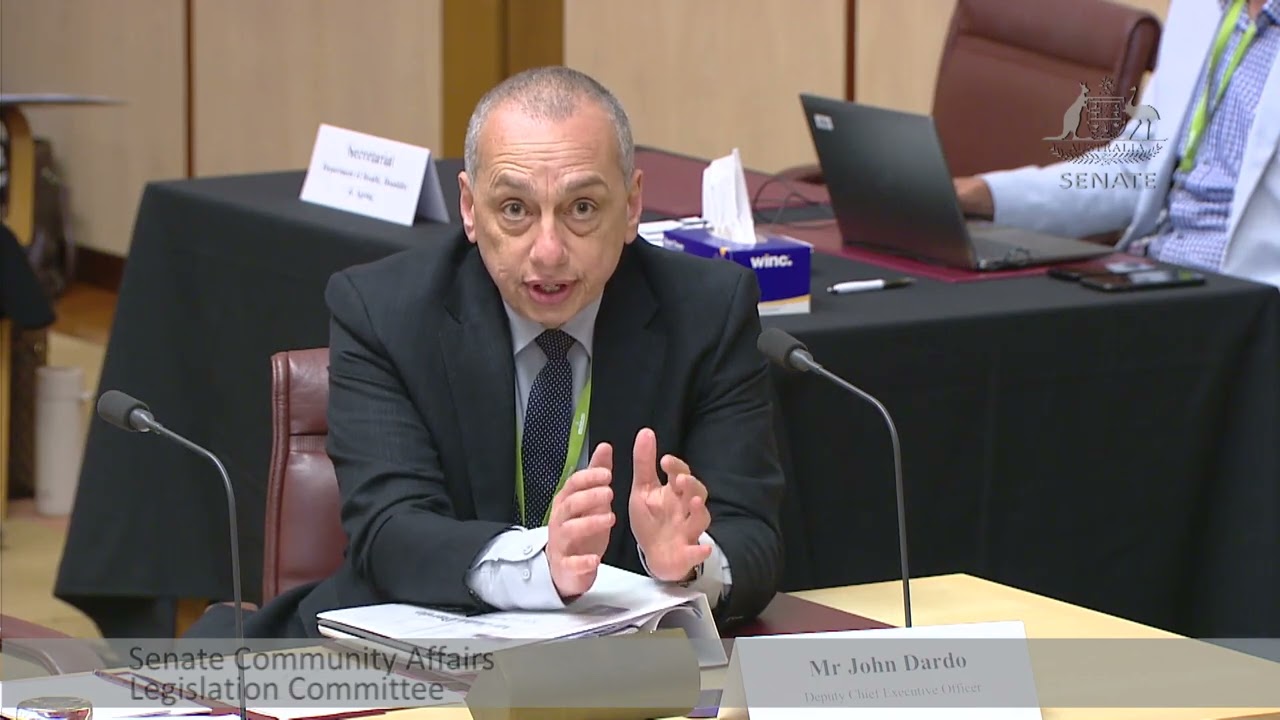
During this session with NDIS officials, I questioned them on their progress in tackling fraud within the scheme.
Here’s an overview of how non-compliance and fraud are being tackled:
👉 29,000 tip-offs received annually, though not all represent actual fraud, with issues ranging from accidental errors to organised crime.
👉 Thousands of Australian Business Numbers are currently placed under manual payment controls and enhanced automated screening.
👉 400 active NDIS investigations are currently being handled by the NDIS Commission and taskforce partners out of 660 total taskforce cases.
👉 25 convictions have been recorded with sentences including up to 6 years in prison. Dozens of more cases are currently in the prosecution phase or awaiting final court sentencing.
Mr Dardo stressed that regulatory oversight relies on a full spectrum of interventions from automated payment blocks to criminal prosecutions to plug integrity leaks effectively.
Every step must be taken to ensure the NDIS remains financially sustainable and accessible for Australians that genuinely depend on it.
Transcript
ACTING CHAIR: Welcome back, everybody. We are on outcome 4, and we will start our questioning with Senator Roberts.
Senator ROBERTS: Thank you for appearing again today. What is the amount forecast to be saved by the proposed cuts to the NDIS program?
Mr Comley: The number in the budget is $37.8 billion over the forward estimates.
Senator ROBERTS: Is that for four years?
Mr Comley: Yes.
Senator ROBERTS: Shouldn’t the priority be to stop wasting money and stop the criminals defrauding the service?
Senator McAllister: We had quite a long conversation about this earlier in the day. To put it briefly, our priority is to stop the criminals defrauding the NDIS. The budget contains very significant investments in the capability of the agency to disrupt fraud, including continuing funding for the Fraud Fusion Taskforce that we’ve spoken about before. The point I was making earlier is that we see some savings to government when we disrupt fraud, but, historically, we’ve seen the vast majority of the money that we identify as going to bad actors returned to people with disability. So, yes, our priority, absolutely, is intervening to stop fraud—non-compliant claiming and other integrity leakage—but whether that is a source of savings to government is a different question.
Senator ROBERTS: What is the answer to that one?
Senator McAllister: The answer is that historically, when we have disrupted providers who are defrauding the NDIS, they are taking money from disabled people. We disrupt it. The money goes back to that person who acquires the services that they need from a legitimate provider. So it’s not a source of savings to government, but it does improve the functioning of the scheme. I’ve said it on many occasions: this scheme has to operate with integrity. Over the period that we have been in government, we have made very substantial investments to lift the capacity of the NDIA and the NDIS Quality and Safeguards Commission to make sure that that is so. There is still more to do, and it’s why there is significant investment—further investment in the budget—that we’ve just brought through.
Senator ROBERTS: So rather than cutting services, you’re cutting fraud?
Senator McAllister: The reform package as a whole seeks to make sure that the scheme is sustainable. Minister Butler has talked about stopping runaway cost growth. He has talked about tackling fraud. He’s talking about reshaping markets so that they deliver good value services and quality services to people with disability. The whole package is about making the NDIS stronger and better so it is here for the long term. It’s not a choice between dealing with runaway cost growth or tackling fraud. We actually have to do both.
Senator ROBERTS: Who are the people whose services will be cut then, if it’s not just fraud?
Senator McAllister: I’ll ask officials to talk you through some of our expectations in terms of the approach that we are taking.
Mr Comley: Perhaps the easiest place to draw from is the public disclosure of information and the lines there where it runs through the composition of the reductions across the forward estimates. I also note in reply to your earlier comment, Senator, that that production of documents includes—as does the budget—the savings measure on both a fiscal balance and underlying cash balance basis. I gave you the underlying cash balance. The equivalent number on fiscal balance is $38.1 billion, so they’re both around $38 billion. There are 10 aspects outlined in that production of documents.
Ms Long: That’s correct.
Mr Comley: I’ll hand over to Ms Long.
Ms Long: The reforms cover a range of areas. That includes addressing fraud, compliance and integrity, but it also includes measures around eligibility and participants’ budgets. Would you like me to go across—
Senator ROBERTS: Yes, please.
Ms Long: As Secretary Comley said, the total impact of the reforms is $38.1 billion over the forward estimates. That can be broken down into a number of components. The first component is around strengthening guidance on what is reasonable and necessary, and that has an impact of $2.9 billion over the forward estimates.
Senator ROBERTS: Is that tightening up on who should get it? I’m using that word ‘tightening’ constructively.
Ms Long: It’s around what is considered reasonable and necessary and how that is applied in terms of the determination of budgets.
Mr Comley: To be clear, that measure is for people that are in the scheme, once they’re in the scheme, on what is considered the right level of support. There are other measures Ms Long will come to that go to the question of who should be in the scheme in the first place.
Ms Long: There’s another element around resetting social, community and civic participation and capacity building budgets, which has an impact of $13.2 billion over the forward estimates.
Senator ROBERTS: What do you mean by that?
Ms Long: There are two particular budget categories. The first one is the social, community and civic participation budget. That’s a type of support that is provided. Another type of support is capacity-building daily activities. Those two types of supports, through a ministerial determination, will have budgets reduced. The social and community budgets will be reduced by 50 per cent. The capacity-building daily activity budgets will be reduced by 10 per cent.
Senator ROBERTS: What do you mean by community activity? What is the scope of that?
Ms Long: It’s quite a broad support category. It provides supports to participants to go out and engage in the community. It might involve having a support worker take them out to engage in some form of community activity, for example.
Mr Comley: It could be as simple as going to a park, maybe having a walk around or feeding the ducks, or it could be a sporting event. It could be a whole range of things. That’s community participation.
Ms Long: Another element of the reforms is around commissioning plan management and support coordination, which would deliver an improvement of around $1.4 billion over the forward estimates. Also, there has been quite a lot of plan inflation that has been observed, so there are a series of reforms that are aimed at addressing that plan inflation. That includes tightening the criteria around unscheduled reassessment requests and ending plans rolling over and funds being rolled over alongside. The total impact of those reforms is $3.1 billion over the forward estimates. There are also a range of access changes, as Secretary Comley referred to. In particular, in introducing an objective test of substantially reduced functional capacity, that would look to tighten eligibility for the scheme in order to focus that back on significant and permanent disability but also to have a focus on substantially reduced functional capacity rather than disability type. That change would have an impact of $9.3 billion over the forward estimates.
Senator ROBERTS: So it’s going to tighten and be more specific?
Ms Long: That’s correct. There will need to be a range of consultation and engagement on how that’s applied in terms of the threshold, the definition and how that’s done in practice, but, yes, the intent is to focus in eligibility on significantly reduced functional capacity. To date, access to the scheme has commonly been done through access lists that relate to your disability type. This would mean that we would no longer need to use those access lists and instead eligibility would be focused on a substantial reduction in functional capacity. If you’d like, I could keep going through a number of the other elements of the reform package, if that’s helpful.
Senator ROBERTS: How many more are there?
Ms Long: There are probably a couple more that I could mention if you like. Another one that might be worth highlighting is there’s a measure for mandatory registration for high-risk providers, which is around, obviously, having registration. That would deliver savings of $0.2 billion over the forward estimates.
Senator ROBERTS: High-risk providers?
Ms Long: That’s correct.
Senator ROBERTS: How do you identify high risk?
Ms Long: I might need one of my colleagues to talk to the detail of how that will be applied.
Ms Alisa Chambers: High-risk supports as imagined through the budget is an extension of mandatory registration that we’re moving through at the moment with supported independent living and platform providers, in the new category of advanced registration. Those high-risk supports relate to daily activities—things like catheter care or really intimate personal care—and closed settings, like respite settings, where we see really significant risk to people with disability, particularly people with significant support needs.
Ms Long: Overall, as a result of the reforms, it’s projected that average growth in the NDIS will be 1.7 per cent over the forward estimates and five per cent over the medium term. Five per cent per annum growth for the NDIS is broadly in line with Medicare and aged-care growth rates. It also means that the scheme will remain steady at around 1.6 per cent of GDP over the medium term on the current projections that we have.
Senator ROBERTS: I had a question about how those people whose services will be cut will be identified. It’s basically through tightening up the eligibility criteria, which is something that we’ve been talking about for a while. That’s good to see, Minister.
ACTING CHAIR: You’ve got about another two minutes, Senator Roberts.
Senator ROBERTS: I’ve got questions for quality and safeguards. We’ve identified several fraudsters who need to be investigated and moneys chased down. Is this where most effort should be used to seek restitution?
Mr Comley: I think the Quality and Safeguards Commission is dealing more with participant safety. The NDIA and Mr Dardo‘s area are more in the area of fraud and misuse of funds. Mr Dardo might want to comment.
Mr Dardo: Overwhelmingly, our focus is on preventing the money going out in the first place so we can prevent the money leaving the system when it shouldn’t be. The beauty of that is you’re not trying to chase a debt. You’re not trying to chase the money after it’s gone. That’s our overwhelming focus, and we’ve done a really, really good job in identifying problematic providers and stopping the funds leaving before they should. When the money has gone, there are different ways that we might recover it. Raising a debt might be one way. Asking the courts for reparation, like an order to repay, might be another. Another way that we’ve done it is we’ve worked with state or federal policing authorities to seize assets or freeze assets. In one recent case, we froze $5 million in assets and had them confiscated by the Commonwealth. In another case, we’ve frozen $40 million in assets. In a recent case, we’ve frozen another $4½ million to $5 million. It’s really important that we send the message that, even if the money has gone and somebody thinks they’ve gotten away with it, we will actually pursue the assets. There is another avenue that we’ve been using, which is to get the tax office to go after them from a tax perspective and raise taxes and attack the problem from that direction. Overwhelmingly, designing a system to stop the money going out in the first place is our mission, but we do have avenues to try to recover money when it gets to the serious end of fraud.
Ms Wade: Secretary Comley mentioned that the commission’s focus with respect to fraud is firmly on the behaviour of providers in the market. In addressing that, in addition to penalty frameworks for providers, we have the registration scheme, and we’ve strengthened our approach to the registration scheme to ensure that it detects fraud in more sophisticated ways through recent reforms. As those registration groups grow, which we just spoke about, that strengthened response for fraud detection continues to be enhanced as well.
Senator ROBERTS: It’s multipronged.
Ms Wade: Yes, absolutely.
Senator ROBERTS: I’ll ask my last question for this bracket. I’ve still got more when we come back. How many cases of fraud are being reported? You said that, if you took them all to court, they’d be clogged.
Mr Dardo: The way we look at it is that it’s about stopping the integrity leakage whether it’s accidental, it’s sharp, it’s malicious or it’s organised crime. We’ve got to stop it all because any one of those vulnerabilities that are open allows money to leak out of the scheme. We get a significant number of tip-offs every year. We get 29,000 tip-offs every year. They are not all fraud. We’ve got to be really careful in assuming. They’re not all fraud. As you go up the spectrum, there are several thousand ABNs that we’ve already got some controls on through manual payment reviews, and we have been building more systems in the last few weeks that are now turning on. We will put a couple thousand more ABNs into those reviews in the next few weeks. Then you go up the spectrum a bit more, where we’ve got Fraud Fusion Taskforce investigations. There are about 660 investigations, but 400 of those related to the NDIS are either with the commission or with us—or both. Then you get to the ones that are in the prosecution phase. There are a few dozen in the prosecution phase, so they’re in front of the courts or we’ve got briefs of evidence with the CDPP to prepare them for the courts. That’s the spectrum. And it’s really important to note that there is no regulatory system in the world that thinks that every single non-compliant thing is going to end up as a prosecution. That is not the way the world works.
Senator ROBERTS: How many convictions have there been?
Mr Dardo: There have been 25 convictions since the Fraud Fusion Taskforce started, and those sentences have resulted, in some cases, in custodial sentences up to six years. There are more cases where there has been a guilty outcome—either pled guilty or found guilty—but they’re awaiting sentencing. We don’t control the dates of the court, so some of those have been sitting there awaiting sentencing for six months or a year. There are cases that are currently scheduled for sentencing in July. They may happen in July; they may happen in December—we don’t know. But there are more cases sitting there right now where they’ve been found guilty awaiting sentencing.