

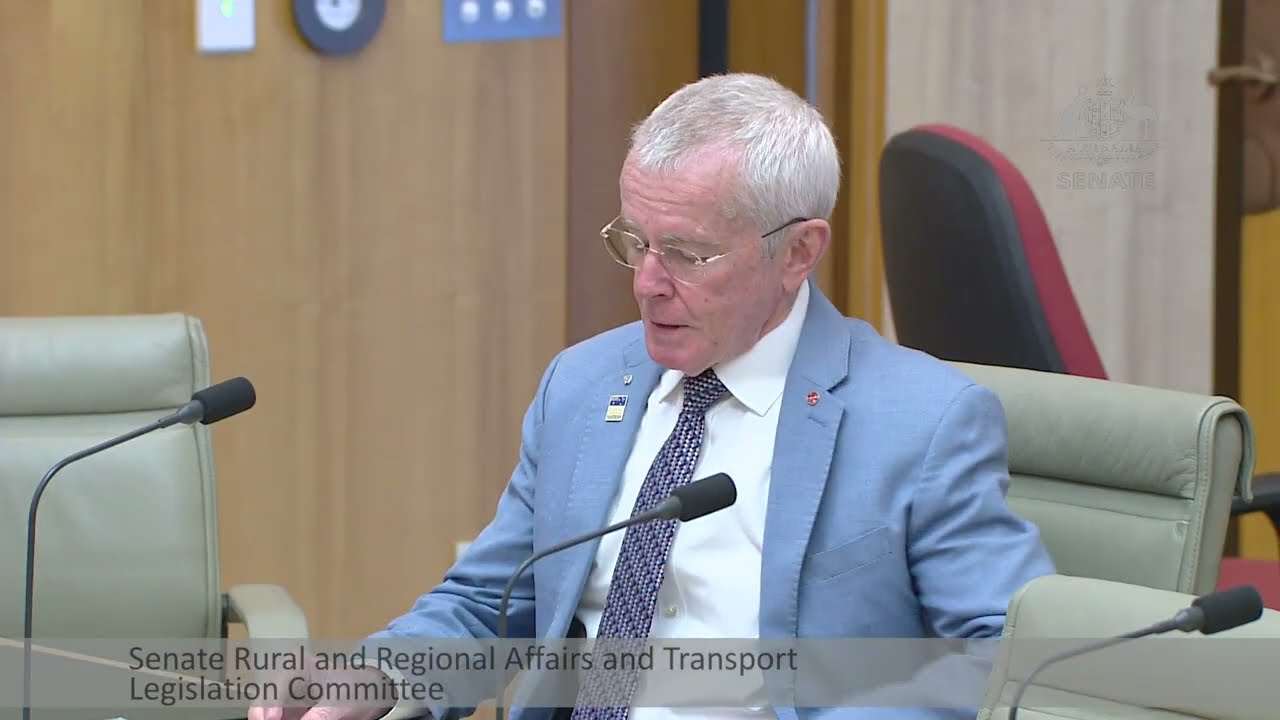
I questioned Minister Murray Watt and departmental officials to get straight answers on how much taxpayer money is being spent on United Nations climate events and whether the government’s policies are hurting economic growth.
I asked the department questions on taxpayer spending regarding Minister Chris Bowen’s role as president of negotiations for COP31 in Türkiye. They confirmed that $147.8 million over three years was allocated under a budget measure titled “Standing with our partners in the Pacific”.
While Dr Box explained this covers events, Pacific delegates, pavilions and staff travel, I asked what the real return on investment for everyday Australian taxpayers was. Furthermore, officials admitted that the total budget for attending COP31 itself and whether grants will again be handed out to climate activists as was done for COP30, has not yet been finalised.
I requested a complete breakdown of international travel costs within the climate change and energy portfolios for the 2026–27 financial year. The Department could not provide specific figures on wages, airfares, or days spent abroad, stating decisions are made on a “case-by-case basis.”
I asked Minister Watt why Australia should have international climate agreements imposed on us, pointing out that sovereign nations like the United States have withdrawn from these arrangements and that the UN cannot enforce anything unless Parliament legislates it.
Transcript
Senator ROBERTS: Thank you for appearing again. Good morning, Minister.
Senator Watt: Good to see you, Senator Roberts.
Senator ROBERTS: You’re looking chirpy.
Senator Watt: Always chirpy, just like yourself.
Senator ROBERTS: The Minister for Climate Change and Energy, Chris Bowen, is the president of negotiations for COP31—the Conference of the Parties—in Turkiye taking place in November this year. Has the department incurred any expense in respect of that role for travel, expense for extra staffing or expense in any other related purpose, and, if so, how much?
Mr Kaiser: Yes. We covered some of that ground in answer to questions from Senator Henderson just moments ago.
Senator ROBERTS: The specific amounts for staffing, travel and related weren’t covered, though, were they?
Mr Kaiser: I think what we said was that a number of staff did travel with Minister Bowen, most recently, as part of his responsibilities but that those figures had not been reconciled yet because, I think, the staff literally arrived home on Saturday.
Senator ROBERTS: Does he have any additional staff as a result of his duties, not just travel?
Mr Kaiser: In terms of his ministerial staff?
Senator ROBERTS: In terms of his position as president of negotiations, does he have any additional staff in his—
Mr Kaiser: In his ministerial office?
Senator ROBERTS: Are the taxpayers paying for anything for the United Nations role?
Mr Kaiser: There was a specific budget measure which provided funding to the department to assist him with that role.
Senator ROBERTS: What is that amount?
Mr Kaiser: My colleagues will be able to help you with that.
Dr Box: I’ll take that, Senator. The amount allocated for the budget measure ‘Standing with our partners in the Pacific’ in the 2026-27 budget was $147.8 million over three years.
Senator ROBERTS: $147 million over three years?
Dr Box: That’s right.
Senator Watt: Just to be clear—because what that money is for shouldn’t be misrepresented—it might be helpful to have Dr Box set out what that money is going to. It’s not to create an office, for example.
Senator ROBERTS: I’m all ears.
Dr Box: The money is for a range of activities: the delivery of the pre-COP, the preparatory meeting in the Pacific, in Fiji, and with the leaders element in Tuvalu; things like sponsored travel for Pacific delegates; additional events in the Pacific; and to support a pavilion at COP31. It also includes some funding for the presidency youth champion and to support our Pacific climate envoys, and of course it also includes some funding for staff and travel.
Senator ROBERTS: Thank you. Was there an amount—I may have missed it—for the cost of attending COP31 itself?
Dr Box: For COP31? No.
Senator ROBERTS: So that is yet to be added?
Dr Box: That budget measure will support attendance at COP31, but the delegation for COP31 and associated costs hasn’t yet been determined.
Senator ROBERTS: Why are the Australian taxpayers, Minister, paying to raise Minister Bowen’s international profile? Where’s the benefit to taxpayers? Where’s the return on investment? What is the return?
Senator Watt: Well, you won’t be surprised to hear me say that that funding is not about raising Minister Bowen’s profile. It’s about ensuring that Australia has a leading role in international negotiations regarding climate change and energy. I know you and I, Senator Roberts, have a pretty different view about whether climate change is real and what we should be doing about it, but the reality is that countries all around the world are negotiating and reaching agreements about this, and our government’s view is that it’s a very good idea and it’s in Australia’s national interests to be helping to lead those negotiations. We’ve got a view that you’d rather be involved in negotiations than have outcomes imposed on you by the rest of the world, and, through Minister Bowen, occupying that role gives Australia a front-row seat in those negotiations. The other reason for us doing this is that it’s an opportunity for greater partnership with our Pacific neighbours. I’m sure, Senator Roberts, one thing you and I could agree on is that the Pacific is a region where there are a lot of national security interests for the Australian people and there is an opportunity for Australia to work in partnership with the Pacific on an issue, being climate change, that they consider to be arguably the biggest challenge they’re facing. That is a good thing for Australia, and dealing with those national security interests as well.
Senator ROBERTS: I think the better way to go about dealing with our neighbours, who are very important to us strategically, is to tell them the truth. That’s much more important for me. You said ‘costs imposed’ or ‘agreements imposed’. The UN cannot impose an agreement on us. The only way it can be imposed is if parliamentarians in this place legislate it.
Senator Watt: Well, again, you and I might disagree on this, Senator Roberts, but our government, and I personally, believe that it is useful to Australia and the Australian people to be part of international agreements about how we manage a range of challenges facing the world. There are some governments around the world that have withdrawn from those sorts of agreements—
Senator ROBERTS: The United States of America, for example.
Senator Watt: For example.
Senator ROBERTS: Keir Starmer calling it now the ending of climate catastrophes— Senator Watt: I don’t think the UK has withdrawn from those agreements, and we think it would be a negative for the Australian people if we were to withdraw from those agreements. I know One Nation’s got a different view. You’re entitled to your view, but we think it’s better to be at the table, in this case in a leadership role, leading the world to negotiate outcomes that are in Australia’s interests.
Senator ROBERTS: Minister, are you aware that 65 per cent of the voters in the recent Farrer by-election voted for a party that wants to end net zero?
Senator Watt: Are you adding the Liberal and National Party votes to your—
Senator ROBERTS: No. We’re not.
Senator Watt: I didn’t think you got 65 per cent.
Senator ROBERTS: No, we didn’t. We got about 40 per cent.
Senator Watt: That’s what I’m wondering—how you got from 40 to 65.
Senator ROBERTS: The other minor parties. Have a look.
Senator Watt: I recognise that there are different views about this in Australia. I think this government has been pretty clear, going into the last two elections, that we support action on climate change and that that is not only a good outcome for our environment but good for our economy and jobs as well. We’ve gone to the election with that policy. We’ve won the last two elections. We’re now implementing that policy. But you’re entitled to a different view.
Senator ROBERTS: I may have missed something here, Mr Kaiser or Dr Box, but COP30 in Brazil was extremely expensive at $1.6 million in taxpayer money. What’s the budget for the actual attendance at COP31?
Dr Box: We don’t have a specific budget for attendance at COP31 yet, because we haven’t determined how many people will go to COP31. The travel to COP31 will be taken from that $147 million that I mentioned that’s in the budget.
Senator ROBERTS: In COP30 you gave away $395,612 in grants to bring along climate change activists and so-called stakeholders. Will you be doing that again in COP31? If yes, why? What is in it for the taxpayer? Mr Rudd took, as Prime Minister, to Copenhagen 114 people, including his hairdresser. Will that same graciousness be extended to Mr Bowen?
Dr Box: You’re correct that we did have a grants program for COP30 that supported a range of organisations to attend COP30 in Belem in Brazil, including youth organisations, First Nations organisations and organisations from a range of sectors, including the agricultural sector. There is funding in the budget to support organisations to attend COP31 in Antalya in Turkiye, but the parameters of that haven’t yet been decided.
Senator ROBERTS: Thank you. I appreciate your direct answers. This next question comes up frequently, so I assume you have the data on hand. What is your budget for international travel within the climate change and energy portfolios—that’s wages, airfare and accommodation—in the 2026-27 financial year? Could you include a breakdown of how much over how many days for how many employees?
Ms Munro: These decisions, in terms of what the required travel is, are always taken on a case-by-case basis. A lot of the work that we do is done virtually, and it’s really by exception that there will be that international travel, but it is necessary to build the relationships and to negotiate outcomes. That’s the responsibility that the government has given us. We don’t have the detail that you are asking for, given that we need to plan through what are going to be the priorities for this year, and, as I said, we make those decisions almost on a case-by-case basis.
Senator ROBERTS: Could you give me a broad idea of the categories of considerations that will go into that or could go into it.
Ms Munro: Go into travel?
Senator ROBERTS: Selecting travelling companions.
Ms Munro: Yes, we’re happy to.
Dr Box: There are a range of factors that we consider. Value for money is obviously a very big consideration. Another is whether the intended meeting outcomes are of significant benefit for Australia’s climate, energy, environment and water agenda. We also consider whether virtual or alternative representation options aren’t suitable, and, of course, all approved travel requests include a contingency. We look at the intended meeting outcomes and whether virtual participation is available and, of course, value for money as an overarching consideration in coordination with the PGPA Act.
Senator ROBERTS: Value for money is a pretty subjective thing. It depends on the goals of your party going there. Coming back to the EPBC Act, your website page for the new national environmental standards under the EPBC Act does not appear to have been updated for some time. It still says that the circulation draft of the new standard would be made available in April, and it wasn’t. When will the new standard be made available to senators?
Senator Watt: I’m not sure when that research was done, but, in the last month, we have begun a second round of consultation on two of those national environmental standards. In outcome 2, we’ll be able to talk to you at length about that.
Senator ROBERTS: Thank you. As things stand, the EPBC Act is, in our opinion—we differ on this, no doubt—a disaster for economic growth in Australia. The Minerals Council of Australia said, and I quote: Average decision times for resources projects have increased by 60 per cent, from 2.3 years in 2019 to 3.8 years in 2025 … What steps are you taking to increase your throughput?
Senator Watt: Again, we could have an extended conversation about this in outcome 2, but that was exactly one of the key reasons for the reforms that we passed in the parliament last year. I know you voted against them, but one of the key objectives of those reforms was to speed up decision-making on projects after that blowout of timeframes that you referred to, and we’re confident that will happen.
Senator ROBERTS: I note that the budget—and you’ve answered a related question from Senator Waters— includes a measure for introducing AI. Will that help in data collection and analysis or will that be actually making decisions?
Senator Watt: Again, we can talk about this in more detail in outcome 2, but the primary purpose of that AI pilot and tool is essentially to help proponents in preparing their applications. There are people who know a lot more about it than me who will be available to talk to you about it in outcome 2.
Mr Kaiser: I’ll just add to the minister’s answer an important principle in the application of AI in the public sector generally, and including in this department, is that humans remain the decision-makers.
Senator ROBERTS: Minister, are you using ludicrously long delays in approvals for minerals projects to discourage application for minerals projects?
Senator Watt: No.
Senator ROBERTS: On a $500 million project, the holding cost of the project across a 3.8-year development application cycle will cost the proponents $25 million per year—almost $100 million total across 3.8 years to four years. How is this not a financial penalty on applicants caused by a procedural failure in your department?
Senator Watt: Again, we can have an extended conversation about this in outcome 2, but a key objective behind the EPBC reforms was to speed up assessments and approvals of projects.
Senator ROBERTS: Let’s get a benchmark going. How many applications for resource projects with a project cost in excess of $50 million are you currently holding, and what is the average age of those projects?
Senator Watt: There will be officials available to answer those sorts of questions in outcome 2.
Senator ROBERTS: What is your expectation for reductions in this figure of 3.8 years? When will the EPBC laws stop getting in the way of economic growth and the breadwinner jobs that go with minerals projects?
Senator Watt: Again, we can talk about that in more detail in outcome 2.
Senator ROBERTS: Can we talk about mining being a driver of the economy, of standard of living, and the six-to-one jobs multiplier in coalmines?
Senator Watt: In my opening statement, Senator Roberts—and I realise you weren’t here for that—I referred to the fact that, along with greater protections for the environment, one of the key objectives behind the EPBC reforms was to speed up decisions around housing, energy and critical minerals projects.
Senator ROBERTS: One of the things that’s become clear with new Labor is that it appeals to activists to get more votes.
Senator Watt: That’s your view.
Senator ROBERTS: Is the government aware, Minister, that obstructing resource projects stifles funds for social and welfare programs for caring for people?
Senator Watt: I would agree with the general proposition that economic development delivers economic wealth for the country that can be used for those sorts of social services.
Senator ROBERTS: And mining is a key to developing economic—
Senator Watt: It’s a big industry. I recognise that.
Senator ROBERTS: Number one exporter.
Senator Watt: It’s a big industry.







Leave a Reply
Want to join the discussion?Feel free to contribute!
Using your first name