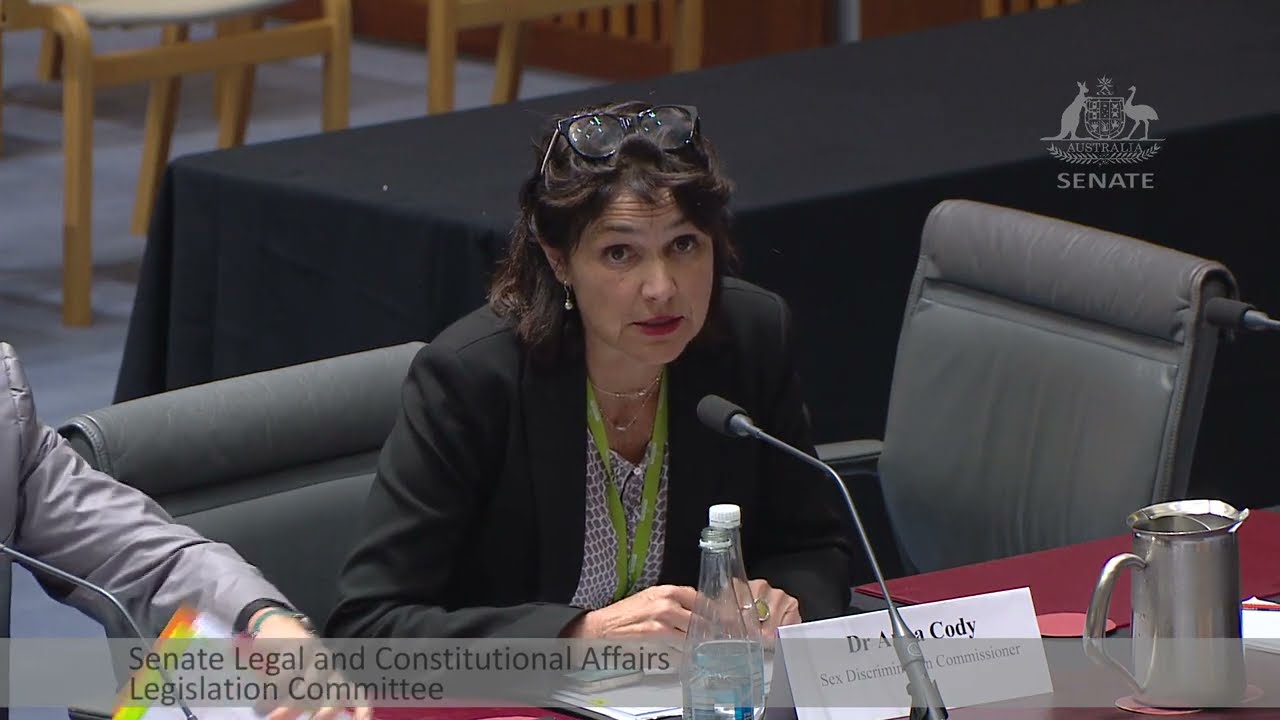

I questioned the Sex Discrimination Commissioner, Dr Cody, regarding the Australian Human Rights Commission’s intervention as an amicus curiae in the Tickle v Giggle case.
I asked Dr Cody whether the Commission could genuinely claim neutrality when participating in the legal action.
I also raised concerns regarding the official report Equal Identities, questioning whether the Commission’s position treats the exclusion of trans females from sex-based spaces as unlawful discrimination under section 5B of the Sex Discrimination Act, and why the office has not actively advised teams and individuals about relevant sport exemptions under section 42.
Additionally, I queried the broader policy approach of recommending the repeal or narrowing of religious and sex-based exemptions, questioning how such positions align with an objective advisory role to the court as amicus curiae or friend of the court.
Finally, I brought up the definition of “gender identity” under the Sex Discrimination Act, specifically the wording regarding a person’s characteristics with or without regard to their designated sex at birth, highlighting my concerns about how these legal definitions operate in practice.
Transcript
Senator ROBERTS: Thank you for appearing here today. Dr Cody, my first question seeks to clear up your role in Tickle v Giggle. You did not prosecute the case and you did not fund the case, yet you presented a legal
opinion in an amicus curiae, a friend of the court, submission. Is that correct?
Dr Cody: That is correct that our role was as amicus curiae to assist the court to understand aspects of the Sex Discrimination Act.
Senator ROBERTS: For clarity, your submission set out the law under the Sex Discrimination Amendment (Sexual Orientation, Gender Identity and Intersex Status) Bill 2013, passed under Prime Minister Gillard. It
changed the definition of ‘woman’, which can now be a person’s self-described gender identity, including appearance, mannerisms or other gender related characteristics with or without regard to the person’s designated
sex at birth. You argued Tickle was a transgender woman with female legal recognition and presentation, and therefore the treatment from Giggle was properly characterised as gender identity discrimination. Other sections around special measures to promote gender equity, including section 7D, were subordinate to the overarching definition of gender in the act. In simple terms, is that your advice to the court?
Dr Cody: No, it wasn’t. We did not make any submissions on whether or not Ms Tickle had been discriminated against. Our role was to assist the court to understand the constitutionality of the 2013 amendments
and to discuss meanings of sex and gender identity within the act, as well as the meaning of ‘special measures’ and how they would apply and any role for exemptions.
Senator ROBERTS: Amicus curiae—pardon my Latin—is a neutral or advisory role to help clarify legal questions. Are you neutral in the Tickle v Giggle case?
Dr Cody: Our submissions were to assist the court to understand and to interpret the Sex Discrimination Act. So, yes, that was our role as an intervener to assist the court.
Senator ROBERTS: Are you neutral?
Dr Cody: Our role was to assist the court to understand the provisions of the Sex Discrimination Act.
Senator ROBERTS: Are you neutral?
CHAIR: Senator Roberts, the commissioner has answered the question.
Senator ROBERTS: How can you be neutral when you marched into court at the head of the scrum of people on the Tickle side of it? You were making a clear statement in that action of support of one side of this case—a personal show of support not appropriate to an amicus curiae role—were you not?
Dr Cody: No, Senator. We took seats in the only space that was available in the courtroom. That’s why we were sitting on the right-hand side of the courtroom.
Senator ROBERTS: I saw your comments in the publication OUTinPerth in April 2024, where you said: We stand with trans communities and will continue to advocate for their rights and the rights of women.
You are making a very clear distinction here between the rights of women and the rights of transgender women. Do you agree your comments amount to a statement that trans women are not women?
Dr Cody: I’m sorry, Senator, could you repeat that question?
Senator ROBERTS: You talk about trans women, and you talk about women. Doesn’t that show that they’re different?
Dr Cody: Transgender women are a subset of the broader category of women. ‘Women’ includes First Nations women, women with disability, older women, younger women, women from culturally and racially marginalised backgrounds, trans women, lesbians—non-binary would sometimes be included in that as well.
Senator ROBERTS: I’ll come back to that. Moving on, this report titled Equal identities plus a long subtitle was published under your name as Sex Discrimination Commissioner. Can I confirm your official position, as
contained in this report, is that trans female exclusion from sex based spaces of services—for example, women-only apps, shelters, sports and bathrooms—is unlawful gender identity discrimination under section 5B of the Sex Discrimination Act. Is that correct?
Dr Cody: No, that’s not correct.
Senator ROBERTS: It’s not correct.
Dr Cody: That’s not what the report refers to and that’s not my position.
Senator ROBERTS: Section 42 of the Sex Discrimination Act provides an exemption specifically allowing sporting organisations to exclude someone, including a trans woman, from a competitive category of strength,
stamina or physique matters in a sport. I haven’t heard your office mention this exemption, which is directly relevant to controversies around, for instance, the Flying Bats Football Club. If you do in fact provide independent advice, as you claim to do in the Tickle case, why haven’t you advised the opposing teams that keep getting injured that there is an exemption to protect them in the act?
Dr Cody: It’s not our role to provide advice to individual parties. We conciliate complaints if someone makes a complaint of unlawful discrimination, and we advocate for the human rights of all people within society,
recognising that all people have a right to equality, respect and dignity. That is human rights law as it applies in Australia.
Senator ROBERTS: Do you want section 42—sport exemption—removed from the act?
Dr Cody: No, Senator. It has a legitimate place to play where strength, stamina and physique are relevant to a sporting activity.
Senator ROBERTS: Why strength, stamina and physique—that distinction between male and female?
Dr Cody: The words are ‘strength’, ‘stamina’ and ‘physique’. Different sports have different requirements around each of those, so that’s an important exemption that, when the parliament passed the Sex Discrimination
Act, it included, to ensure that sport enabled people to participate fully within it.
Senator ROBERTS: Let’s move on. Your report recommends repealing or narrowing exemptions in the Sex Discrimination Act—such as section 43A—that allow sex based or faith based exclusions. Broad religious
exemptions are criticised as creating uncertainty and legitimising exclusion. What right do you have to present an amicus curiae brief when you are already clearly heavily biased in favour of Tickle and opposed to religious freedom?
Dr Cody: Our role within the Australian Human Rights Commission is to advocate for the human rights of everybody within our community. That is a part of our role as a national human rights institution. Our role as
amicus curiae is a different role. We’re not advocating in that situation but rather providing clarification to the court on the meaning of the Sex Discrimination Act.
Senator ROBERTS: I note that the Gillard government legislation that caused this ludicrous outcome passed on the voices, with former senator Birmingham—then-head of the Liberal Party in the Senate—on behalf of the coalition calling the bill ‘a very welcome piece of legislation’ and specifically supporting the absurd and illogical gender identity provisions. I’m just clarifying the record. Dr Cody, what is the difference between gender identity and gender? In your answers to Senator Cash you implied there was a clear difference between gender identity and gender. What is the difference?
Dr Cody: I was referring, in my answer to Senator Cash, to how sex is understood within law and in terms of the protections provided in discrimination law. Sex looks at three aspects. Those are biology and physical
characteristics as well as how someone presents themselves as well as their social recognition. Those are the three aspects that relate to how sex is understood under the Sex Discrimination Act and within discrimination law more broadly.
Senator ROBERTS: What about with regard to the differences between gender identity, or people who identify as a gender, and real gender? Does it apply there?
Dr Cody: Within the Sex Discrimination Act, I can refer you to the provision for gender identity, but I don’t have it to hand right at the moment.
Senator ROBERTS: So gender identity is a construct of the law. Is that correct?
Dr Cody: Gender identity is protected as a protected attribute within the Sex Discrimination Act. It’s not only an aspect of the law.
Senator ROBERTS: If someone introduces a bill that says men are the same as women, and it gets through the Senate and the House, that’s the law. Is that correct?
Dr Cody: It’s up to the parliament to pass its own laws, Senator.
Senator ROBERTS: Right. So the parliament can say, ‘Men are the same as women’—end of story, that’s it. Is that right? Thank you. What is the meaning of ‘gender identity’ and ‘gender’?
Dr Cody: Gender identity—if you’d like me to refer to the Sex Discrimination Act?
Senator ROBERTS: Could you read it out, please.
Dr Cody: Yes, certainly.
CHAIR: Senator Roberts, I’m going to share the call after this.
Senator ROBERTS: Okay. I have another set later.
CHAIR: I’ll allow Commissioner Cody to answer your question and then I’m going to share the call.
Senator ROBERTS: Can you come back to me later?
CHAIR: Yes.
Dr Cody: Gender identity, within the Sex Discrimination Act, means ‘the gender related identity, appearance or mannerisms or other gender related characteristics of a person—whether by way of medical intervention or not—with or without regard to the person’s designated sex at birth’.
Senator ROBERTS: The keyword would seem to be ‘or’. I’m not a lawyer, I’m not a judge, but that would seem to be the keyword, and it’s used twice in the definition, separating the three characteristics. So you don’t
have to have a gender; you can be whatever you want to be if you identify as such or if you dress as such. Thank you very much.