

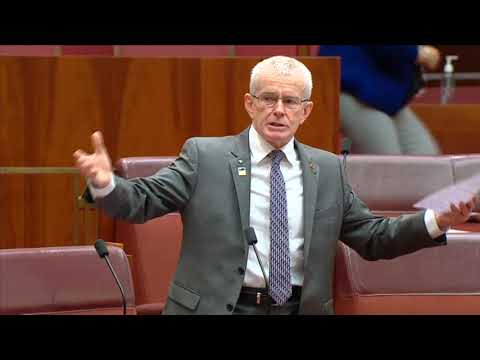
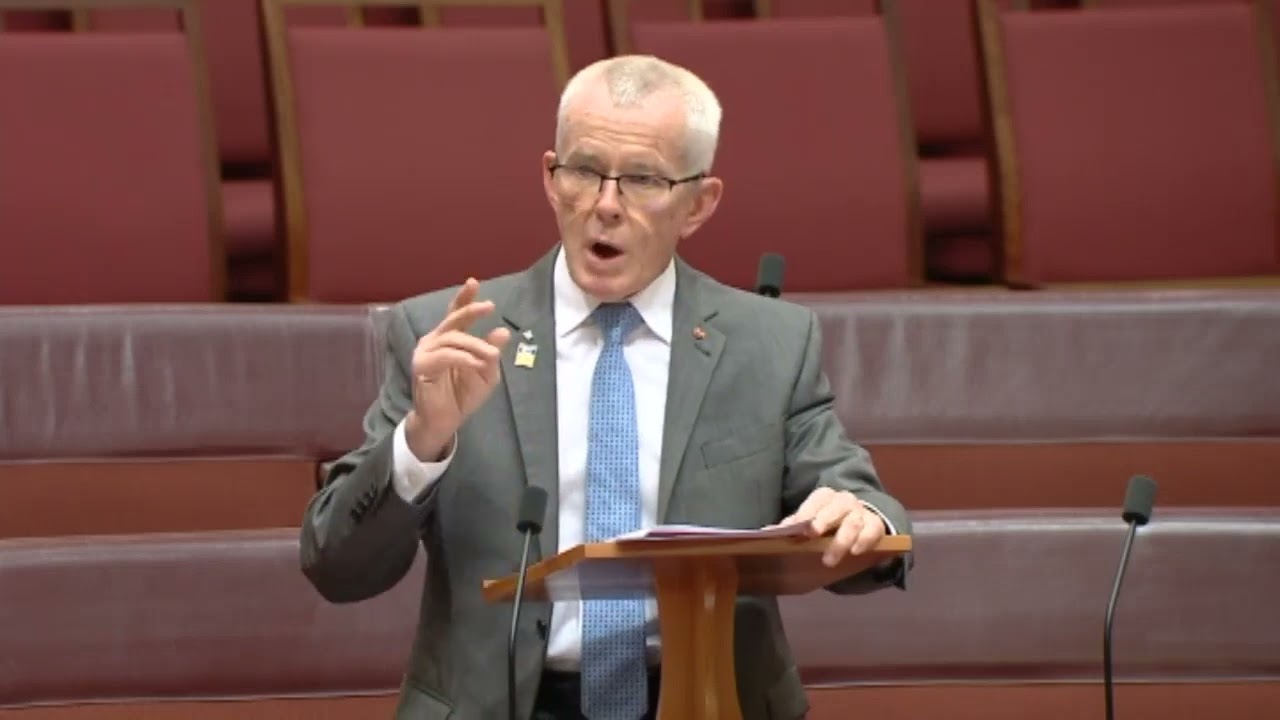
In this estimates session with the Australian Curriculum, Assessment and Reporting Authority (ACARA), I asked whether they can attribute any measurable improvements in education outcomes (such as academic performance or attendance) to its 17-year history.
Mr Gniel defended ACARA’s role, clarifying that its KPIs are tied to its legislative functions, namely, developing the national curriculum, administering national assessments (like NAPLAN) and reporting data. He noted that education outcomes are a shared responsibility involving teachers, parents and state education systems.
I raised concerns about state autonomy, referencing New South Wales’ “back-to-basics” syllabus reforms from early 2025 and suggesting the national curriculum is overly complex. Mr Gniel responded that all state and territory ministers approved the Australian Curriculum, and that state-level documents are simply a localised framework to enact it.
I asked whether ACARA was pushing “propaganda” and “indoctrination,” pointing to Freedom of Information (FOI) documents regarding the UN’s UNESCO Greening Education Partnership. Did ACARA perform due diligence on climate change science integrated into the curriculum? Mr Gniel rejected the premise of indoctrination, stating the curriculum is evidence-based and approved by all education ministers.
Transcript
Senator ROBERTS: Thank you for appearing today, ACARA. Thank you, Minister. ACARA was founded in 2009. After 17 years, are there any improvements in education indicators which can be shown to result from your work?
Mr Gniel: We publish information about the performance of students across the country every year through the national results, and we only have that information because ACARA runs national assessments. Certainly at a subgroup level we’ve seen some improvements. We’ve also seen some more challenging areas. ACARA’s responsibility around reporting is making sure that that is available to education ministers across the country, to systems, to schools and to the broader community. I think it’s obvious—and I’m sure you would agree—that education outcomes for all children are not a single entity’s responsibility. We rely on the great work of our parents, as the first educators of our children, through to schoolteachers, principals and those groups that support them. ACARA’s role is around curriculum—making sure we have a national curriculum; assessment—sure we have a national assessment program that provides that information; and reporting, which has been delivered every year as per the functions we have in our legislation.
Senator ROBERTS: I admire your point that the education of a child involves many, many people right through the community. I accept that, but is there any improvement that’s come as a result of your work? Academic performance, attendance, course continuation, education costs, teacher satisfaction, which is very important—can we attribute any of those, or any others measures, to ACARA’s work? What KPIs are you measured on?
Mr Gniel: The KPIs for us are within the functions of our legislation, which is that we produce and administer the Australian curriculum. I think we can tick off that we have done that. That’s been in place for a number of years now. In fact, as you would be aware, we’ve just been through a significant review and republication of that, in 2022, with the approval of all ministers around the country, which is no small feat. That’s certainly one of the KPIs for us, against our legislation. We’ve also run the National Assessment Program, year on year, for nearly 20 years now, as apart of that. We’ve delivered the reports, through the national reporting. They are the KPIs, in terms of what we’re responsible for delivering, whereas responsibility for the improvement in outcomes, as I said before, is a shared endeavour.
Senator ROBERTS: What about a metric suggestion? You produce a national curriculum, which is guidance about what should be in the coursework, right?
Mr Gniel: Sorry—what’s the question in that?
Senator ROBERTS: There’s not a question there. You produce a national curriculum, which is guidance about what should be in the coursework. Am I right?
Mr Gniel: The national curriculum provides the content and achievement standards, and it’s what we collectively expect our children to develop in terms of knowledge, understanding and skills. That’s implemented across Australia through the jurisdictions, who have the constitutional right for delivery of education, as I’m sure you’re aware.
Senator ROBERTS: Yes.
Mr Gniel: That then is translated into each and every school. Of course, some of those nearly 10,000 schools I was talking about before are in the bush, in remote communities. Others have thousands of kids in the middle of the city. That is why we hand that to the profession, to teachers and principals, to translate content and achievement standards—our expectations, our promise to children in our community. They need to do that with the children that are in front of them. Of course, those children are aged from five to 18. So those are the things that change.
Senator ROBERTS: Quite a range.
Mr Gniel: It is, absolutely. Yes. To go to your point, Senator, what we provide is content and achievement standards—what we want children to learn and then demonstrate. The translation of that into everyday practice, though, of course happens in the classroom.
Senator ROBERTS: What percentage of coursework in active use in schools around Australia follows your national curriculum?
Mr Gniel: Ministers have approved the adoption of the Australian Curriculum. Some of the jurisdictions use that in their classrooms directly. Other jurisdictions choose to adapt the Australian Curriculum, using the curriculum as a backbone and then providing further supports for schools. For example, in New South Wales they have the syllabus documents, and they’re the things that they’ll provide to their schools for delivering in their classrooms.
Senator ROBERTS: Thank you. In early 2025, the New South Wales education minister, Prue Car, publicly positioned the New South Wales government’s reformed syllabus as a slimmer—to quote her—’back-to-basics’ alternative to your national curriculum, which was criticised as overly complex or ‘bizarre’. Have you failed in your core mission to produce a curriculum which is high quality or indeed even usable? I must commend Mr Minns, the Premier of New South Wales, for having the courage to do what he did.
Mr Gniel: Sorry. What’s the question there? If you can provide me with what you’re quoting from, that would really help, because I just want to be clear about what the minister said in this before I respond to that.
Senator ROBERTS: I’m quoting from news reports.
Mr Gniel: Of the minister’s—
CHAIR: Are you able to distribute the statement?
Senator ROBERTS: No. My staff did the research on it.
Mr Gniel: In that case, I’ll just say that the New South Wales minister for education at the time, along with all other ministers, approved the Australian Curriculum. So have we delivered on that responsibility and function? Absolutely. We don’t position the Australian Curriculum in competition with New South Wales syllabus documents. They’re fundamentally different. If you go on their website, Senator, the New South Wales syllabus documents are their way of enacting the Australian Curriculum. It’s very clear. So these are not in conflict. They are part of New South Wales supporting their teachers and schools to deliver the Australian Curriculum and provide the guidance through syllabus based documents.
Senator ROBERTS: My staff do excellent research, and I can recall the statement from New South Wales early last year about getting back to basics.
CHAIR: It would assist the committee, Senator Roberts, if you bring a copy of the documents. Thank you.
Senator ROBERTS: Yes. Victoria and Western Australia use a modified curriculum. Is your next version going to take on the criticism from the states and dial down on the woke and whatever they mean in New South Wales by the word ‘bizarre’?
Mr Gniel: Again, I don’t agree with that, and I’d want to see the document you’re referring to. Again, all ministers from around the country approved the Australian Curriculum. It is then up to the states and territories to deliver education. I’ve mentioned before that that is part of the Constitution. The fact that they then maintain that responsibility to translate that into things that are particular for their communities, I think, is absolutely appropriate.
Senator ROBERTS: So, when a state or a state education department approves the national curriculum, it doesn’t mean it’s going to abide by it?
Mr Gniel: I’d say there are two parts to that. They approve the national curriculum, as they’ve all done. The delivery of the Australian Curriculum is in the Australian Education Act, and all school authorities and systems are required to deliver the Australian Curriculum or another curriculum approved by ACARA.
Senator ROBERTS: So ACARA controls either the national curriculum or any alternative curriculum?
Mr Gniel: ACARA is responsible for writing and administering the national curriculum—the Australian Curriculum—and also for the approval of any curriculum that can be considered as an interpretation of that Australian Curriculum but still with the same level of content. For example, Steiner education and Montessori are the two that we’ve currently got on there—and also International Baccalaureate.
Senator ROBERTS: Thank you. Freedom of information LEX 81815 and 82204 appear to show that ACARA are adding the United Nations UNESCO Greening Education Partnership to the curriculum, which requires the inclusion of nationally determined contributions in the curriculum. This suggests you’re not dialling back but doubling down on the propaganda. Why are you pushing indoctrination over education?
Mr Gniel: Senator, I probably have to reject most of the assumptions that you’ve made in that question. To go to your question, you mentioned the numbers related to an FOI. Can you just explain to me what that FOI is and if you’ve got a copy of it for us.
Senator ROBERTS: I don’t.
Mr Gniel: Right. I think, Senator, you’d appreciate—
Senator ROBERTS: I can’t get across everything—every FOI that we cite. My staff make sure it’s—but I’ll get it to you.
Mr Gniel: Great. I think the CHAIR has asked for the previous one as well. If you can provide those for us then I think we’d be in a better position to be able to answer. I’m happy to take that one on notice, but I do want to make sure that it’s also on notice that I do not agree with the assumptions about us indoctrinating children. The Australian Curriculum is a promise we make to our children. It is approved by all Australian ministers— Commonwealth, state and territory. So I completely reject those statements.
CHAIR: Perhaps you can work with the secretariat to lodge the original document with the question on notice.
Senator ROBERTS: Certainly. The UNESCO Greening Education Partnership is a voluntary global initiative launched in 2022 aimed at integrating climate change education and sustainability across education systems. Did you check the scientific basis for the greening education program and, in particular, climate change education, or did you just take what the UN is feeding you?
Mr Gniel: We haven’t taken—I mean, this is where, Senator, I really need you to provide the information you’re basing this on so I can provide the answer appropriately.
Senator ROBERTS: It’s really simple: did you just take what the United Nations claims is science and put that into the curriculum, or did you do your due diligence?
Mr Gniel: Once you’ve provided me with the details about specifics of what you’re talking about, I’m very happy to provide you an answer.
Senator ROBERTS: That was the previous question. Now I’m talking about a very simple question: did you take the UN propaganda or UN material on climate science, or did you do the due diligence on it?
Mr Gniel: Senator, again, if you provide the specifics on that, I can then give you an answer on the specifics. But I can give you a general answer, which is that the Australian Curriculum is based on the evidence that we gather as part of the process for both the development of the curriculum and also its review, and that’s taken through the ACARA board and on to ministers for their approval. As you would expect, they are very keen to make sure it is based on the evidence, and that’s what we have in the Australian Curriculum.
Senator ROBERTS: By ‘evidence’ you mean scientific proof?
Mr Gniel: Again, Senator, I think ‘scientific proof’ is a fairly broad term, if I can put it that way. I’d like to see the specific one that you’re asking about.
Senator ROBERTS: Earlier this year in a Senate inquiry, I asked a senior UN executive in charge of information to provide the scientific proof. She failed to provide it. What she gave me was complete crap. What due diligence did you do on the United Nations material?
Mr Gniel: I think I’ve answered that, Senator. I’m happy to take on notice, when you provide the specific example of what you’ve asked me to check, whether we’ve put that and used that in the Australian Curriculum. I’m very happy to.
Senator ROBERTS: You’ll get it.
Mr Gniel: Great. Thank you, Senator.
CHAIR: Thanks, Senator Roberts.






Leave a Reply
Want to join the discussion?Feel free to contribute!
Using your first name