

Chief Financial Officer Mr Lyons of The Bureau of Meteorology (BOM) stated that their total budget/revenue for 2026–27 is $723,346,000, which includes a capital component of $100,846,000. The exact expenditure figures for the current year are still in development.
The BOM’s budget has nearly doubled since 2017–18 (when it was under $400 million). What caused this “massive cost blowout?” What is the comparison of staff numbers between 2017–18 and the present?
As they did not have the historical figures on hand, they have taken the question on notice.
I then questioned BOM officials about an incident in South-East Queensland where a severe weather warning predicted up to 200–300 mm of rain (leading to local council flood activations), but only 30 mm actually fell in Brisbane. The BOM frequently over-forecast and their predictions are so often wrong.
Dr Minchin responded that rainfall forecasting is not a perfect science and involves significant uncertainties and probabilities. While acknowledging forecasts will sometimes be incorrect, she maintained that on average, the BOM is accurate.
I disagree! BOM data consistently overstates rainfall, so I asked if this was done deliberately to “perpetuate myths about climate.” Dr Minchin strongly denied this, while Michael Logan added that their probability forecasts are well-calibrated based on validation data.
I asked – why do farmers often find third-party services like Weatherzone to be more accurate? Are BOM’s algorithms leaning towards predicting hotter and drier conditions?
Dr Minchin again defended the BOM’s accuracy, explaining that third-party providers simply package and present data differently to suit diverse user preferences. They said that the Bureau freely shares its data with partners like Weatherzone.
The BOM is filtering its forecasts through an ideological lens, and this is costing farmers money and the economy food production.
Transcript
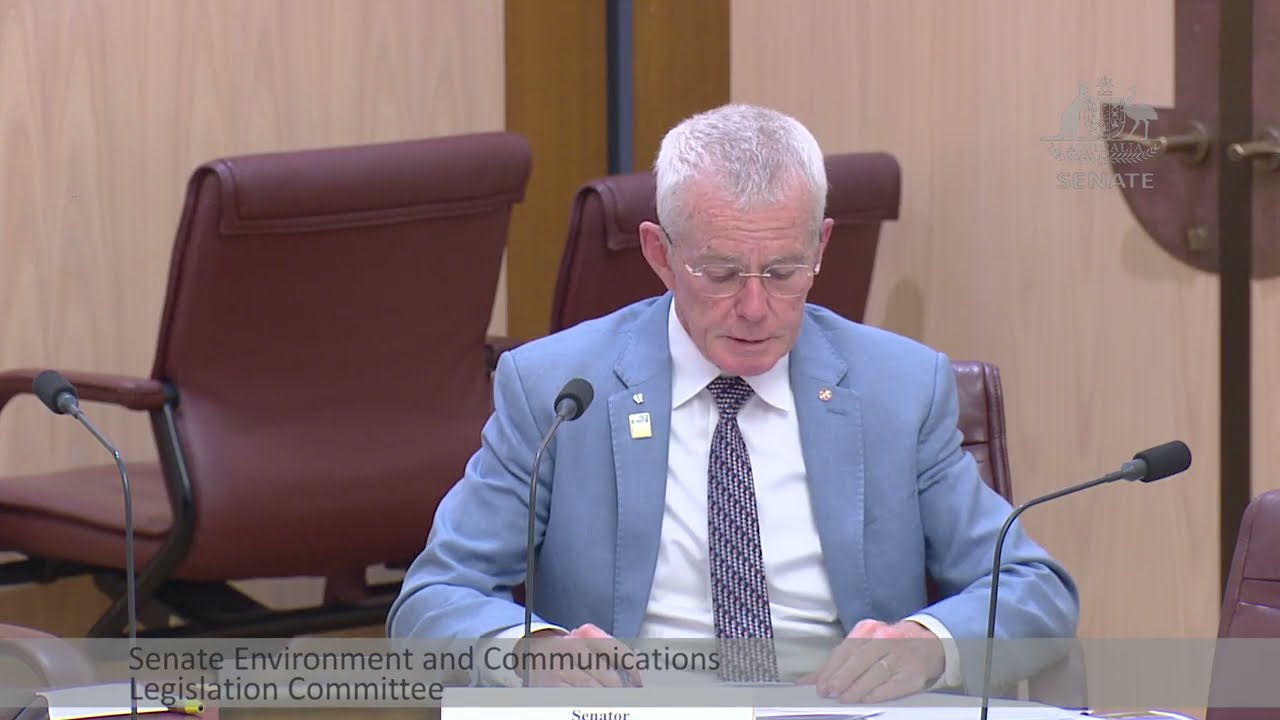
Senator ROBERTS: Thank you for appearing again. Please confirm your expenditure for 2025-26, which would include operating expense, special purpose allocations, your own revenue and capital expenditure. What is it?
Dr Minchin: I will pass to Astrid Heward, my chief operating officer, to answer that question for you.
Ms Heward: Can you repeat the items that you were looking for?
Senator ROBERTS: What you spent totally—operating expense, special purpose allocations, own revenue and capital expenditure.
Ms Heward: I’m actually going to call the chief financial officer up for this one.
Mr Lyons: In the recently published public benefit statements in the May budget, the overall revenue for the bureau will be $753 million. That makes up both our operating and capital components. The actual expenditure for this year is still in development. That’s our revenue that we’re working towards for both. Capital is $100,846,000.
Senator ROBERTS: What’s the budget for 2026-27?
Mr Lyons: Sorry, that’s the 2026-27.
Senator ROBERTS: What the total amount for budget?
Mr Lyons: It is $723,346,00.
Senator ROBERTS: In 2017-18, your budget was under $400 million. Now it’s $723 million. What’s causing the massive cost blowout in the Bureau of Meteorology. Why? I’ll ask another question. How many staff did you have in 2017-18, and how many now?
Ms Heward: We’d have to take that on notice.
Senator ROBERTS: You don’t know?
Ms Heward: We don’t have the 2017 and 2018 figures in front of us, I’m sorry.
Senator ROBERTS: That’s one of the key figures. Has anyone been fired for wasting $96 million of taxpayer money?
Dr Minchin: We don’t believe $96 million was wasted, so no-one has been fired.
Senator ROBERTS: Let’s move on. In February, the BOM predicted—the Bureau of Meteorology has defended its warnings—a weekend deluge in Queensland, leading local councils to activate major flood response measures, only for as little as 30 millimetres of rain to fall. Meteorologist Angus Hines said on Thursday: … some of those higher-end numbers could certainly exceed 200mm, but I wouldn’t rule out one or two locations getting 300mm in the next few days … Brisbane ultimately measured just 30 millimetres of rain across the entire weekend, with the Sunshine Coast hinterland recording up to 60 millimetres. This is becoming a joke in South-East Queensland: ‘catastrophic floods imminent’, and we get 30 millimetres. How did the forecast get it so wrong and how does it happen so often?
Dr Minchin: I think one of the challenges that we have with perceptions in the community is that people think that forecasting rainfall is a perfect science. It’s not. It comes with uncertainties—significant uncertainties. So, when we provide a forecast, we provide a range of probabilities, and we do our best to ensure that the public have the best information that they can rely on for their decision-making. There are always going to be times when our forecast is not correct. I want to be clear on that: there will always be times when our forecast is not correct, but, on average, we will get it right.
Senator ROBERTS: I have this graph, from the BOM website, I believe, on ‘rainfall range reliability’. You repeatedly overstate the rain—repeatedly. If it were natural variation, some would be below, some would be above. This is repeatedly overstated. Is that to perpetuate myths about climate, because of our water shortage?
Dr Minchin: Absolutely not. We have a rigorous program of assessing the accuracy of our forecasts, and I’ve asked Michael Logan, who’s a general manager in our forecasting area, to provide a little bit more explanation of the validation that we do for the accuracy of our forecasts.
Mr Logan: That’s correct—that is posted on our website, and we are talking about the probability forecasts for rainfall and the rainfall ranges that we do provide on there. We are finding that we are honing those, over the years, as they go on. For example, when we looked at the last financial year and the probabilities for the next day rainfall, when the bureau forecasts indicated a 25 per cent, 50 per cent or 75 per cent chance of exceeding a certain amount of rainfall, observations showed that that forecast rainfall was exceeded 19 per cent, 49 per cent and 80 per cent of the time, respectively. So the forecasts are pretty well calibrated, but we are absolutely constantly working to make sure that they are as calibrated as we can possibly get them, and, over time, we’re focusing on making sure that is for the higher end rainfall. But all rainfall is very important.
Senator ROBERTS: Last question, Chair; I’ll put the rest on notice. I still don’t have an explanation for why farmers tell me Weatherzone is more accurate than the BOM—when they take your data, then reanalyse it themselves. Is there something in your algorithms that leans towards predicting hotter and drier conditions than Weatherzone do? Elders Weather actually adds Weatherzone data to their own rural stations, to produce accurate forecasts in the bush—more accurate than yours. Have you thought of licensing Elders’ own station data to make your data more accurate?
Dr Minchin: There is no doubt that there are a range of different ways that the Australian public, including farmers, can access weather data, not just from the bureau’s forecasts. We stand by our accuracy, as has been identified by Michael, about the way that we assess that. There is always the ability for other providers to package data in a way that is more accessible to different audiences, and we encourage that third-party engagement. We provide our data to partners like Weatherzone to ensure that they’re able to deliver to their audiences the information that they want. That’s not a reflection of our accuracy or lack of accuracy. This is about different preferences. The challenge we have is that we have 28 million customers in Australia and they all have slightly different preferences for how they want to receive their weather information. We are trying our best to meet all of those needs at all times. The farming sector is a key sector for us that we treat very seriously, and we try and get our information as correct as we can through that process.






Leave a Reply
Want to join the discussion?Feel free to contribute!
Using your first name