

$147.8 million has been allocated over three years in the 2026-27 budget under the measure “Standing with our partners in the Pacific,” to support activities related to Climate Change and Energy Minister Chris Bowen’s role as COP31 president.
Officials clarified that the money is not being used to create a new office, but to fund Pacific preparatory meetings in Fiji and Tuvalu, a COP31 pavilion, Pacific delegate travel, climate envoys, and departmental staff travel. Specific costs and delegate numbers for attending COP31 itself have not yet been finalised.
Similar to COP30, which included grants for youth, First Nations, and agricultural stakeholders, funding has been set aside to support external organisations attending COP31, though final parameters are still under review.
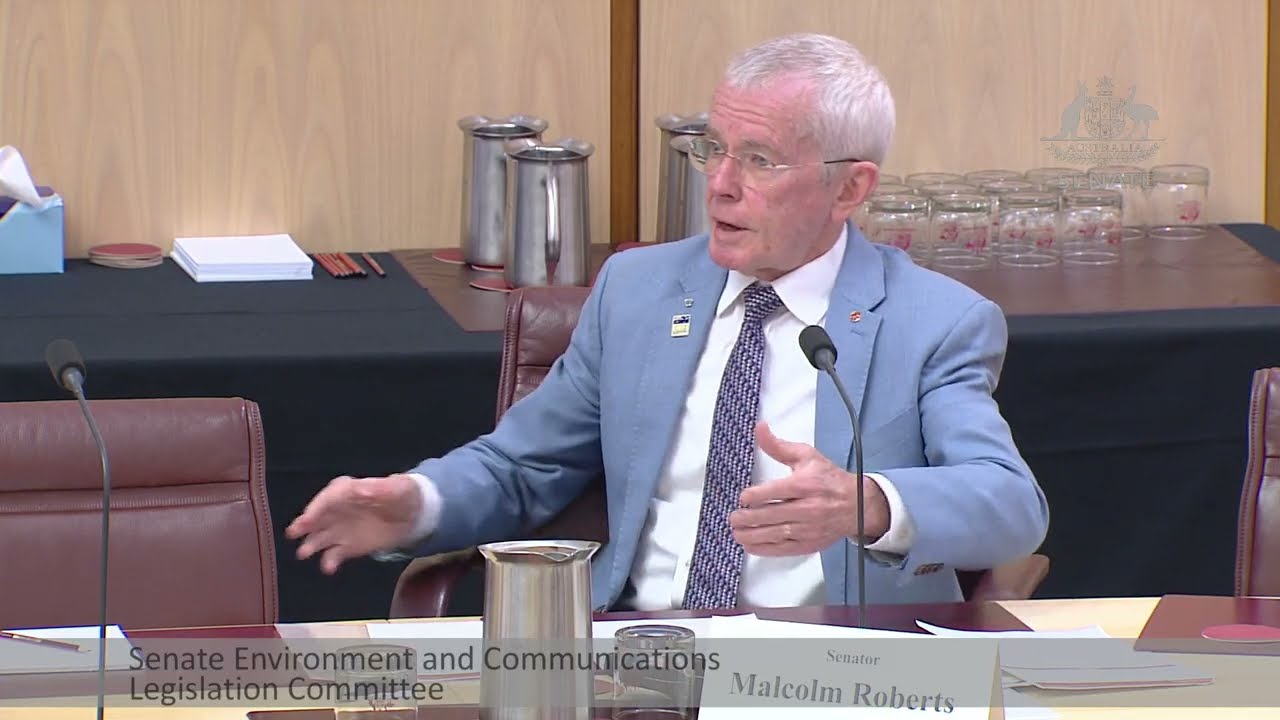
I questioned the return on investment for taxpayers and criticised government climate spending, pointing out that international agreements hold no domestic weight unless legislated by Parliament, which can be unwound by a new government with a simple piece of legislation.
Senator Watt defended the expenditure, stating that Australia holding a leadership role secures a “front-row seat” in global negotiations, protects national security interests through partnership with the Pacific, and aligns with the government’s electoral mandate on climate action.
One Nation is committed to abolishing the Department of Climate Change and related agencies, programs, and regulations. These government-funded climate initiatives and international climate agreements are economically damaging and a misuse of taxpayer funds.
Transcript
Senator ROBERTS: Thank you for appearing again. Good morning, Minister.
Senator Watt: Good to see you, Senator Roberts.
Senator ROBERTS: You’re looking chirpy.
Senator Watt: Always chirpy, just like yourself.
Senator ROBERTS: The Minister for Climate Change and Energy, Chris Bowen, is the president of negotiations for COP31—the Conference of the Parties—in Turkiye taking place in November this year. Has the department incurred any expense in respect of that role for travel, expense for extra staffing or expense in any other related purpose, and, if so, how much?
Mr Kaiser: Yes. We covered some of that ground in answer to questions from Senator Henderson just moments ago.
Senator ROBERTS: The specific amounts for staffing, travel and related weren’t covered, though, were they?
Mr Kaiser: I think what we said was that a number of staff did travel with Minister Bowen, most recently, as part of his responsibilities but that those figures had not been reconciled yet because, I think, the staff literally arrived home on Saturday.
Senator ROBERTS: Does he have any additional staff as a result of his duties, not just travel?
Mr Kaiser: In terms of his ministerial staff?
Senator ROBERTS: In terms of his position as president of negotiations, does he have any additional staff in his—
Mr Kaiser: In his ministerial office?
Senator ROBERTS: Are the taxpayers paying for anything for the United Nations role?
Mr Kaiser: There was a specific budget measure which provided funding to the department to assist him with that role.
Senator ROBERTS: What is that amount?
Mr Kaiser: My colleagues will be able to help you with that.
Dr Box: I’ll take that, Senator. The amount allocated for the budget measure ‘Standing with our partners in the Pacific’ in the 2026-27 budget was $147.8 million over three years.
Senator ROBERTS: $147 million over three years?
Dr Box: That’s right.
Senator Watt: Just to be clear—because what that money is for shouldn’t be misrepresented—it might be helpful to have Dr Box set out what that money is going to. It’s not to create an office, for example.
Senator ROBERTS: I’m all ears.
Dr Box: The money is for a range of activities: the delivery of the pre-COP, the preparatory meeting in the Pacific, in Fiji, and with the leaders element in Tuvalu; things like sponsored travel for Pacific delegates; additional events in the Pacific; and to support a pavilion at COP31. It also includes some funding for the presidency youth champion and to support our Pacific climate envoys, and of course it also includes some funding for staff and travel.
Senator ROBERTS: Thank you. Was there an amount—I may have missed it—for the cost of attending COP31 itself?
Dr Box: For COP31? No.
Senator ROBERTS: So that is yet to be added?
Dr Box: That budget measure will support attendance at COP31, but the delegation for COP31 and associated costs hasn’t yet been determined.
Senator ROBERTS: Why are the Australian taxpayers, Minister, paying to raise Minister Bowen’s international profile? Where’s the benefit to taxpayers? Where’s the return on investment? What is the return?
Senator Watt: Well, you won’t be surprised to hear me say that that funding is not about raising Minister Bowen’s profile. It’s about ensuring that Australia has a leading role in international negotiations regarding climate change and energy. I know you and I, Senator Roberts, have a pretty different view about whether climate change is real and what we should be doing about it, but the reality is that countries all around the world are negotiating and reaching agreements about this, and our government’s view is that it’s a very good idea and it’s in Australia’s national interests to be helping to lead those negotiations. We’ve got a view that you’d rather be involved in negotiations than have outcomes imposed on you by the rest of the world, and, through Minister Bowen, occupying that role gives Australia a front-row seat in those negotiations. The other reason for us doing this is that it’s an opportunity for greater partnership with our Pacific neighbours. I’m sure, Senator Roberts, one thing you and I could agree on is that the Pacific is a region where there are a lot of national security interests for the Australian people and there is an opportunity for Australia to work in partnership with the Pacific on an issue, being climate change, that they consider to be arguably the biggest challenge they’re facing. That is a good thing for Australia, and dealing with those national security interests as well.
Senator ROBERTS: I think the better way to go about dealing with our neighbours, who are very important to us strategically, is to tell them the truth. That’s much more important for me. You said ‘costs imposed’ or ‘agreements imposed’. The UN cannot impose an agreement on us. The only way it can be imposed is if parliamentarians in this place legislate it.
Senator Watt: Well, again, you and I might disagree on this, Senator Roberts, but our government, and I personally, believe that it is useful to Australia and the Australian people to be part of international agreements about how we manage a range of challenges facing the world. There are some governments around the world that have withdrawn from those sorts of agreements—
Senator ROBERTS: The United States of America, for example.
Senator Watt: For example.
Senator ROBERTS: Keir Starmer calling it now the ending of climate catastrophes— Senator Watt: I don’t think the UK has withdrawn from those agreements, and we think it would be a negative for the Australian people if we were to withdraw from those agreements. I know One Nation’s got a different view. You’re entitled to your view, but we think it’s better to be at the table, in this case in a leadership role, leading the world to negotiate outcomes that are in Australia’s interests.
Senator ROBERTS: Minister, are you aware that 65 per cent of the voters in the recent Farrer by-election voted for a party that wants to end net zero?
Senator Watt: Are you adding the Liberal and National Party votes to your—
Senator ROBERTS: No. We’re not.
Senator Watt: I didn’t think you got 65 per cent.
Senator ROBERTS: No, we didn’t. We got about 40 per cent.
Senator Watt: That’s what I’m wondering—how you got from 40 to 65.
Senator ROBERTS: The other minor parties. Have a look.
Senator Watt: I recognise that there are different views about this in Australia. I think this government has been pretty clear, going into the last two elections, that we support action on climate change and that that is not only a good outcome for our environment but good for our economy and jobs as well. We’ve gone to the election with that policy. We’ve won the last two elections. We’re now implementing that policy. But you’re entitled to a different view.
Senator ROBERTS: I may have missed something here, Mr Kaiser or Dr Box, but COP30 in Brazil was extremely expensive at $1.6 million in taxpayer money. What’s the budget for the actual attendance at COP31?
Dr Box: We don’t have a specific budget for attendance at COP31 yet, because we haven’t determined how many people will go to COP31. The travel to COP31 will be taken from that $147 million that I mentioned that’s in the budget.
Senator ROBERTS: In COP30 you gave away $395,612 in grants to bring along climate change activists and so-called stakeholders. Will you be doing that again in COP31? If yes, why? What is in it for the taxpayer? Mr Rudd took, as Prime Minister, to Copenhagen 114 people, including his hairdresser. Will that same graciousness be extended to Mr Bowen?
Dr Box: You’re correct that we did have a grants program for COP30 that supported a range of organisations to attend COP30 in Belem in Brazil, including youth organisations, First Nations organisations and organisations from a range of sectors, including the agricultural sector. There is funding in the budget to support organisations to attend COP31 in Antalya in Turkiye, but the parameters of that haven’t yet been decided.







Leave a Reply
Want to join the discussion?Feel free to contribute!
Using your first name