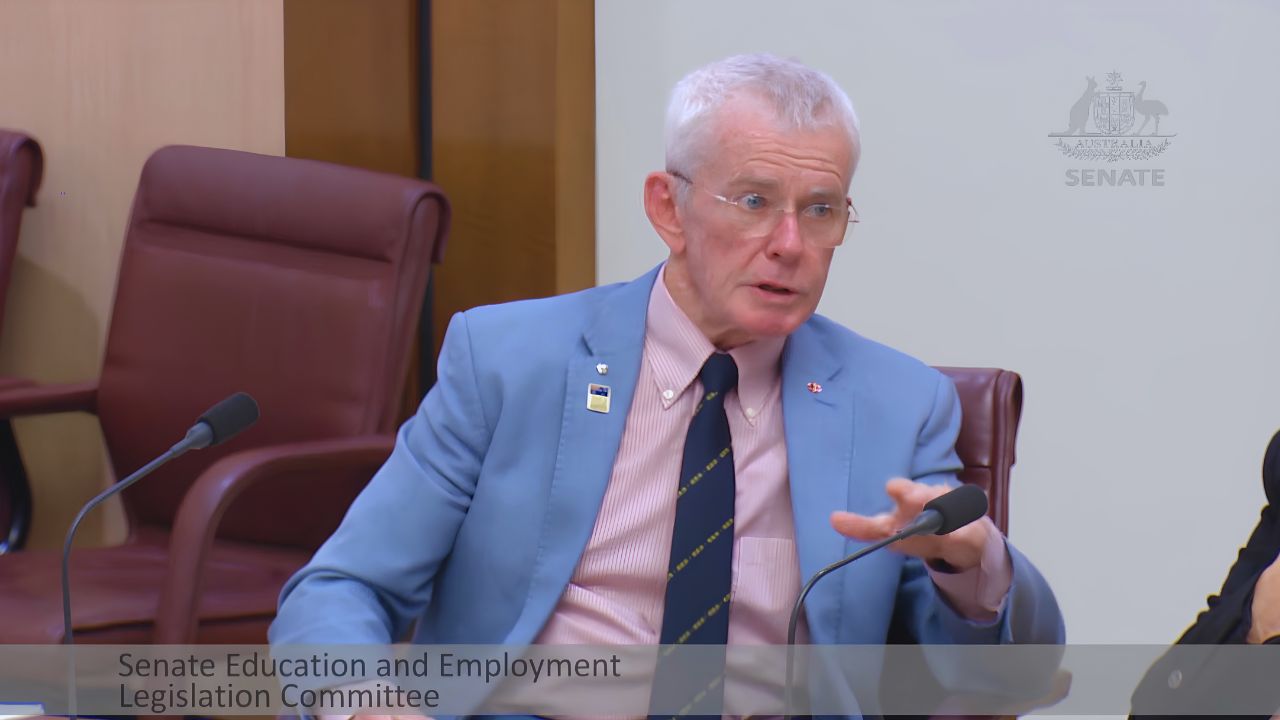

During the June Estimates sessions, I exposed a regulator unwilling to confront the obvious – thousands of coal miners have been underpaid for years while the Fair Work Ombudsman hides behind outdated enterprise agreements and technical excuses.
Miners provided evidence and the regulator ignored it. Awards required permanency and enterprise agreements undermined it. Australia’s largest wage-theft scandal, affecting an estimated 5,000 workers, continues because no one in authority will confront it.
This session laid bare a system that has failed miners, failed the award, and failed it’s statutory duty to uphold a fair minimum safety net.
If the system won’t protect workers, someone has to call it out.
One Nation will always call it out.
Transcript
Senator ROBERTS: Thank you for appearing again, Ms Booth.
Ms Booth: Thank you, Senator Roberts.
Senator ROBERTS: Would you agree, as a matter of principle and community expectation, that no worker in Australia should be paid less than that required under a relevant award that applies to the worker?
Ms Booth: What I would say is that all workers in Australia should be paid their legal entitlements.
Senator ROBERTS: Mr Furlong had no trouble in confirming what I just said—twice. Are you familiar, Ms Booth, with the 2016 case where the Fair Work Commission found that an enterprise agreement between the Shop, Distributive and Allied Employees’ Association and Coles was invalid because the enterprise agreement paid below the award?
Ms Booth: I’m not personally familiar with that case, but we can take questions on notice about it and its relevance to the FWO activities, if you wish.
Senator ROBERTS: Thank you. Would you agree that this ruling of the SDA sets a clear legal precedent that any enterprise agreement that pays below the award, even when the Fair Work Commission endorses such an enterprise agreement, is invalid?
Ms Booth: Since I’m not familiar with the case, I wouldn’t comment on it. Ms Volzke might be familiar with it and might be able to give you further insight.
Ms Volzke: I think we’ve discussed at previous Senate estimates hearings that the Fair Work Commission applies the better off overall all test, or BOOT, in determining whether or not an agreement can be approved, and, so long as it passes that test, that agreement will be approved.
Senator ROBERTS: I will ask it again, Ms Volzke. Would you agree that this ruling sets a clear precedent that any enterprise agreement that pays below the award, doesn’t meet the BOOT, even when the Fair Work Commission endorses it, is invalid?
Ms Volzke: At previous estimates, we’ve also spoken about the mechanisms that might be available to an aggrieved party if they wish to seek to set aside an enterprise agreement, and that would usually be one of the parties that is a party to that agreement.
Senator ROBERTS: I noticed that you didn’t agree or disagree. I’ve repeatedly raised with the Fair Work Ombudsman the situation of casually engaged coal workers subject to the black coal mining industry award being paid less than the casualised award rate when employed by labour hire companies utilising enterprise agreements. We’ve previously discussed that a quantity of cases with specific details have been referred to the Fair Work Ombudsman and the Fair Work Ombudsman has investigated. Can you tell me how many individual investigations have been completed?
Ms Booth: As you know, Senator Roberts, a number of investigations are underway. Mr Ronson is in charge of that, and we’ll ask Mr Ronson to come up and give you a report on our progress.
Senator Watt: While Mr Ronson is coming up, Senator Roberts, you are absolutely right that you have raised these issues a number of times at estimates, and every time I have reminded you that the One Nation party voted against our same job, same pay laws, which were designed to fix this problem.
Senator ROBERTS: Because those laws were designed to cover up the problem.
Senator Watt: No, they weren’t.
Senator ROBERTS: They were designed to cover up. We mentioned it at the time, in the Senate.
Senator Watt: Can you point out to me the section of the act that covers up this?
CHAIR: This is a debate at another time. Mr Ronson.
Mr Ronson: What I can confirm is that, in our black coal mining investigation, we’re about two-thirds of the way through, so we’re in the home stretch. The figures I can give you are these. Since we commenced this activity, we’ve investigated 56 cases and we’ve finalised 35, and, since I last provided evidence to this committee, we have received six new cases. We finalised 18 cases since our last update. Importantly—and I think this is relevant to the particular cohort of workers you’ve been interested in—we’ve now issued preliminary finding letters to all the workers represented by the Independent Workers Union of Australia. They have all our preliminary findings, whereby they’ve been given an opportunity to review those letters and findings, and, if they have any additional or new evidence or they disagree or confirm the findings, they have an opportunity to make submissions to us, as do the other parties.
Senator ROBERTS: Is that a secure mechanism?
Mr Ronson: They’ve got an opportunity to say ‘you’ve got this right,’ or ‘you’ve got this wrong,’ or ‘we agree with you’ or ‘you’ve missed that.’ But these are at quite an advanced stage, and so we’re confident that, within the next month or two, we should have finalised nearly all investigations.
Senator ROBERTS: What’s the total number of complaints you’ve received? The total number is still outstanding.
Mr Ronson: There are 21 cases outstanding, but, since we began this discrete activity, it’s 56 investigations, and 35 finalised.
Senator ROBERTS: Plus six new.
Mr Ronson: Since I last gave evidence, there have been six new ones. But we haven’t had a new case since February.
Senator ROBERTS: I’ve received feedback on a number of completed Fair Work Ombudsman investigations from coalminers that have been affected. The Fair Work Ombudsman seems to be consistent in saying, ‘As the Fair Work Ombudsman has determined that’—the named person—’terms and conditions are governed by’ the named labour higher enterprise agreement, ‘we do not consider that the black coal mining industry award 2010 applied to the person named.’
Mr Ronson: Yes.
Senator ROBERTS: And, ‘Consequently,’ the Fair Work Ombudsman says, the named persons’ ‘wages and entitlements during the relevant period should not be derived from the award,’ but rather the named labour hire enterprise agreement. In light of the rulings in relation to the SDA case of 2016 and the Fair Work Commission general manager, why does the Fair Work Ombudsman now take the view that paying a worker less than the award is justifiable if the worker is being paid under a certified EA? On what legal basis does the Fair Work Ombudsman justify this?
Ms Booth: I think we’re going to hear from Ms Volzke again, and it will traverse the same topic, and that is the legal framework within which we operate, and our job is to assess whether or not that framework has been breached. Perhaps Ms Volzke will elaborate again for you.
Ms Volzke: I can’t talk to all of those outcomes of those investigations, but, thematically, and with a lot of those historical complaints also, we took the approach of assessing the situation where the agreement might apply, which was our view, but also, in the event that the agreement didn’t apply, we also looked at the situation of whether the underlying award might be relevant. In that case, as we’ve spoken about in previous estimates hearings, the legal consequences can be unclear as to whether or not that particular employee might have received an underpayment under the award anyway. That’s because, as you know, the black coal mining award doesn’t provide for casual employees in operational roles.
Senator ROBERTS: There are a number of things there that I’m going to come back to. In relation to the actual comparing of paid rates, one assessment by the Fair Work Ombudsman that I’ve seen compares full-time rates under the award with casual rates under the enterprise agreement. The data provided by the Fair Work Ombudsman quotes the following rates and labels: contract rate per hour, $46.50. What’s the contract rate per hour?
Mr Ronson: In those findings, what that would mean is the payment that employee would have received, so this would be a contract rate under a common law contract of employment. In that situation, you’ve got your common law contract of employment, but then there are also minimum entitlements in this country, informed by either an award or an enterprise agreement. But that contract rate would have been the rate that employee received.
Senator ROBERTS: Sure. Then there is the award minimum rate, $21.97—these are your classifications.
Mr Ronson: Yes, that would have been either a relevant agreement rate—
Senator ROBERTS: This is award minimum rate.
Mr Ronson: Or an award rate, at the time. This could be back in 2017 or 2018. Some of these cases have gone back years.
Senator ROBERTS: The enterprise bargaining agreement 2012 minimum rate is $23.10.
Mr Ronson: Again, that would have been the lawful minimum entitlement at that time in that particular situation for that worker.
Senator ROBERTS: These are your figures again: named enterprise bargaining agreement 2012, casual rate, $28.88.
Mr Ronson: That’s right. What Ms Volzke has been explaining is that the peculiarity of this whole sector is that enterprise agreements provide for casual rates because it’s been approved by the Fair Work Commission, but the black coal award doesn’t provide for casual production employees. This is the whole peculiarity of this sector.
Senator ROBERTS: So these quoted rates omit important information and should in fact read as follows, in our opinion, based on the rates easily accessible under the award. Your award minimum rate should be the award minimum rate without entitlements. It’s the same figure, $21.97.
Mr Ronson: I’m just presuming that, in that particular case, because there’s no casual provision in the award, we’re at a loss. We can’t confect one. There is no such thing. This is the very odd nature. So we’re reliant upon that contractual rate that they received.
Senator ROBERTS: So the award has a rate plus entitlements, and what you’re doing is forgetting the entitlements and just taking the rate, even though the casuals should be paid a loading for all of those entitlements.
Mr Ronson: No, I would imagine that, in those cases, there would be an enterprise agreement that would be at play.
Ms Volzke: Because the award provides for the full-time rate, but the casual rate isn’t derived from the award. It can be the from the agreement, but also, potentially, if there is no agreement, it may well be that those particular employees are actually award and agreement-free, which would mean they would be covered by the national minimum wage.
Senator ROBERTS: That’s the first time I’ve heard that one.
Mr Ronson: It’s case by case. There are 56 cases. There will be nuances and changes on each one, but typically, for the cohort that has the historical complaints, it’s pretty much the same. It’s the same issue that you’ve been advocating for, agitating for, for some time.
Senator ROBERTS: So let me add another one: award, notional, casualised rate. That comes to $50.01. Remember that figure. Then, where you’ve got named EBA 2012, minimum rate, we’ve added ‘without entitlements.’ What you’re doing is taking a minimum rate, stripping away the entitlements, not even counting them, and you’re saying that’s the case because—what was it, Ms Volzke?
Ms Volzke: If there is an enterprise agreement that has been approved by the Fair Work Commission, then that displaces anything that might have otherwise applied in the underlying award, and then the employment conditions are what’s in the agreement. If there is no underlying agreement, you cannot extrapolate the full-time provisions in the award to casuals because, as Mr Ronson has already said, in those production roles, there is no classification for casual employees.
Senator ROBERTS: Are you telling me, Ms Volzke, that, if the minimum rate is the same in the award and the enterprise agreement, because there’s no casual, the casual worker misses out entirely on all the other entitlements? Isn’t that paying less than the enterprise agreement, by a long, long way?
Ms Volzke: No. For an agreement to be approved by the Fair Work Commission, the Fair Work Commission must be satisfied that the agreement passes the BOOT, the better off overall test. That will obviously depend on the particular matter and agreement that’s before it. I am only talking at a high level. I won’t make any particular conclusions about specific case examples, but that is the general principle—and, where the agreement has been validly approved, the conditions of employment are derived therein.
Mr Ronson: What Ms Volzke is saying is that, where the agreement is in play—and that’s mostly the cases that you’re aware of—the agreement knocks out the award; the agreement trumps, in terms of the industrial instrument that informs the rates. But what I can tell you is that—
Senator ROBERTS: The enterprise agreement, even if it’s inferior to the award, trumps the award.
Mr Ronson: If it’s a lawful agreement, it trumps, yes; it displaces the award.
Senator ROBERTS: It can’t be lawful, but we’ll come back to that.
Mr Ronson: Okay. What I can say is that this is one of the reasons we were very careful to set out our findings very carefully and provide the parties with opportunities to see whether we’ve got anything wrong—and I can confirm that we’ve received no significant evidence that will alter the findings that we’ve made. It might not be the outcome that the employee wants, but it is the application of the law.
Senator ROBERTS: That is, the named casual worker should have been paid a minimum of $50.01 per hour for the period. On evidence in pay slips supplied to the Fair Work Ombudsman, the named worker was paid $39.55 per hour. That’s less than your contract rate.
Mr Ronson: Correct, but—
Senator ROBERTS: All entitlements wiped.
Mr Ronson: I don’t have that case in front of me, but that case would have been based upon what is the minimum entitlement that applies to this worker in this period, at this time and at this site, and that’s how we would have done the calculations and worked out whether there was a financial injury.
Senator ROBERTS: The named labour hire EBA rates that the Fair Work Ombudsman quotes omit requirements for entitlements and in this respect are arguably misleading as to the truth. The rate actually paid is less than the award, less than your contract rate and less than the award notional casualised rate. How could the Fair Work Ombudsman get such basic information so wrong?
Mr Ronson: What I’m trying to say is: out of all the preliminary findings we’ve issued, we’ve had no evidence received in response from parties that would impact or alter our findings. It may not be the outcome that people want, but it is the correct application of the law, in our view.
CHAIR: Senator Roberts, at the start of your questions, I asked each senator to keep their questions to 15 minutes. We’ve now gone over that time.
Senator ROBERTS: Can I have one question, and then I’ll hand over the call.
CHAIR: Yes, thank you.
Senator ROBERTS: And then I’d like another block. The miner supplied the Fair Work Ombudsman with all his pay slips. What period did the Fair Work Ombudsman consider in assessing the worker’s complaint—one year or the whole period of underpayment?
Mr Ronson: The whole period.
Senator ROBERTS: Thank you. I’ll come back.
Trancript
Senator ROBERTS: I will return to my questioning. Ms Booth, I refer to the Fair Work Ombudsman’s decision in relation to the miner, appendix C in this case, clause 9, which says, ‘No time or wage records were available during the relevant period.’ From whom?
Ms Booth: That would be a detail in relation to a particular investigation that I wouldn’t have visibility of. Mr Ronson, do you?
Mr Ronson: I’m going to presume, but correct me if I’m wrong, that the case that you’ve got in front of you probably relates to the 14 cases represented by the Independent Workers’ Union of Australia. 10 of those cases remain ongoing, so preliminary findings have been issued. From what you have just put, it looks like that’s an attachment to the preliminary findings, which gives an opportunity for the worker and the employer to respond if there’s any contradiction. Your question was about time and wage records not being available. That would be from either party. I’m not sure what particular period or history this is, but it may be that there were no timely wage records available.
Senator ROBERTS: I’m advised that the miner supplied his pay-slips and the Fair Work Ombudsman had the miner’s total hours and pay and could calculate the overall hourly rate. So it’s not from the miner.
Mr Ronson: Okay. If there’s a concern, this is the opportunity to put this evidence to us if there’s something that we’ve missed. This is why we put the preliminary findings out, just in case there’s a question mark over what our findings are. We try to do our investigations to the best of our ability, to be as thorough as we can using the powers we have, but, if we’ve missed something and the parties have evidence, please provide it to us. This is exactly why this process has been undertaken.
Senator ROBERTS: Thank you. Ms Booth, were you previously a Fair Work Commission member?
Ms Booth: Yes, I was, from 2012 to 2020.
Senator ROBERTS: Did any of the enterprise agreement applications you approved as a member include an enterprise agreement covering casual coal miners?
Ms Booth: Of course, I would be relying on memory. I don’t recall any. Indeed, throughout my time at the Fair Work Commission I spent a lot of time being the national practice leader of what’s called the Collaborative Approaches Program now, which took me out into the field, and I was relieved of the obligation to approve enterprise agreements quite early on in my time in the commission. I couldn’t tell you which year that was but, for a large part of my time in the commission, I was relieved, very kindly by the President, of that obligation. I don’t recall any black coal cases, but the Fair Work Commission website still has every single decision that I have ever made under my name, and it can be examined to see whether or not any of those enterprise agreements fell within my purview.
Senator ROBERTS: Did you ever check the BOOT?
Ms Booth: When I did approve enterprise agreements, yes. Indeed, in the early part of my time in the Fair Work Commission, a member was required to do that personally. Then, as I went on towards 2020, the administrative support was provided and a BOOT report was provided to each member from the administrative staff to aid our examination of an enterprise agreement.
Senator ROBERTS: Thank you. I want to go to section 134(1) of the Fair Work Act, which provides, The Fair Work Commission must ensure that modern awards, together with the National Employment Standards, provide a fair and relevant minimum safety net of terms and conditions.’ The use of the term ‘must’ imposes, does it not, a mandatory legal obligation on the commission?
Ms Booth: I’ll say two things about that. One might be asking Ms Volzke to comment on the provisions of the act. I’ve not got it in front of me. I will be careful not to provide evidence to the committee other than from my current role as the Fair Work Ombudsman. I was happy to answer your questions about the Fair Work Commission, but of course I no longer speak for the Fair Work Commission. What I would say about the modern award objective is that every member, myself included, would have given consideration to all the factors listed in section 134.
Senator ROBERTS: Before you hand over to Ms Volzke, does the commission—because you’re investigating a commission decision, ultimately—have the liberty to bypass, dilute or ignore this statutory duty—’must … provide a fair and relevant minimum safety net of terms and conditions’.
Ms Booth: The modern awards objective applies in certain circumstances, not every dispute and not every case, but, where it applies, it is my understanding that at the time I was a Fair Work Commission member I was obliged to weigh all the factors that were in the modern awards objective in any decision that I was making. I would refrain from saying anything more about what I did in those times, because my memory will be faulty and the Fair Work Commission is no longer my area of work.
Senator ROBERTS: I wasn’t clear. I wasn’t referring to your time in the Fair Work Commission. I’m referring to the Fair Work Commission decisions in this case.
Ms Booth: I think I’ve given you my answer.
Senator ROBERTS: As I understand it, the Black Coal Mining Industry Award says that production workers must be permanent workers, permanent employees. How do you get over that condition in an enterprise agreement?
Ms Volzke: I haven’t got the terms of the award in front of me, but it doesn’t provide for casual employment in those production roles. You will remember as well that, in Closing Loopholes, the same job, same pay audit provisions came in that ensured that labour hire workers—
Senator ROBERTS: This happened well before that.
Ms Volzke: Absolutely, but what I’m saying is that anomaly, in the way that you’ve described it, going forward has been closed. We’re talking about, in some circumstances, agreements that were approved many years ago. As the regulator, we must apply the law as it stands at the particular point in time, and that’s exactly what we’re doing. As we’ve spoken about previously as well, a number of these historical matters are outside our statutory time frame for being able to prosecute them, but we are doing our very best to investigate them irrespective of that. That’s what we’re undertaking to do. Mr Ronson has provided some details on that already, and we hope to have that wrapped up soon. I’m very satisfied that we’re doing the best that we can in the circumstances to apply the law to these particular cohorts of employees.
Senator ROBERTS: I’m not. Whether it’s been legal, or negligence or deliberate, this is Australia’s largest wage theft scam, and it’s continuing—Australia’s largest wage theft. It’s widespread. We estimate that around 5,000 miners are still being screwed by this. Does that bother you?
Ms Volzke: As I said, the closing loopholes legislation in 2023 closed that loophole. Going forward, that is what the law is now, but our statutory mandate is to apply the law as it applies at a particular point in time, and these are historical matters.
Senator ROBERTS: Doesn’t the Fair Work Ombudsman’s decision endorse the breach of the Fair Work Act and what amounts to the Fair Work Commission’s endorsement of Australia’s largest wage theft due to collusions between union bosses and large global multinational employers, including an offshoot in Australia of the world’s largest labour hire firm, Recruit Holdings?
Ms Volzke: As we’ve spoken about previously, if an agreement has been approved by the Fair Work Commission, then it is part of the legal framework that we must apply, and that is what we’ve done.
CHAIR: Senator Roberts, as I indicated at the start of your block of questioning, as we have two senators seeking the call, we’re seeking to split the time, so that’s the conclusion of your block of questions.
Senator ROBERTS: Thanks, Chair.