Posts

“I understand the law. What I don’t understand is the science around XX and XY ….”

— Australia’s Sex Discrimination Commissioner, during Senate Estimates.

How can you advise the court on sex-based rights if you don’t understand the science? Seriously!

Transcript

Senator ROBERTS: Thank you. I’d now like to go to Dr Cody, and the intervention in Tickle v Giggle, please. Thank you for appearing, Dr Cody. Tickle v Giggle is the case of someone who was born a biological male being stopped from joining a women-only app. What are you arguing in your intervention? How much are you being paid by the taxpayers to go in and bat for biological born and developed men to be allowed into women’s spaces?  

Dr Cody: The role that we have within the case Giggle and Tickle is intervention, or amicus curiae: helping the court to understand the interpretation of the Sex Discrimination Act and the amendments from 2013, and also how the Convention on the Elimination of All Forms of Discrimination Against Women applies, whether or not there are special measures, and their understanding of section 5 and section 7 of the Sex Discrimination Act. We were given leave by the court to assist them to understand those issues and also the constitutionality of the Sex Discrimination Act. In terms of the cost, we have two counsel who were briefed. Both agreed to appear on a capped fee basis, so that’s a reduced fee. One was paid $13,000, and the other one was paid $10,000.  

Senator ROBERTS: What I actually asked, Dr Cody, was how much are you paid by the taxpayers to go in and bat for biological born and developed men?  

Dr Cody: My salary is similar to that that you mentioned for Commissioner Sivaraman.  

Senator ROBERTS: About $400,000 a year, plus 15.4 per cent super?  

Dr Cody: Correct.  

Senator ROBERTS: Thank you. Just so I can be clear, your position is that the law means a biological man who identifies as a transgender woman can enter a female-only space?

Dr Cody: I would question whether or not Roxanne Tickle is not a man. She is a trans woman. She has gone through various processes and has transitioned, and she’s a trans woman. So she has access—or sought access and was provided access—to the Giggle for Girls app, and then was taken off the access to the Giggle for Girls app.  

Senator ROBERTS: What sort of chromosomes does she have—XX or XY?  

Dr Cody: I can’t answer that. 

Senator ROBERTS: You can’t?  

Dr Cody: No, I can’t answer that.  

Senator ROBERTS: Wow. Can someone who was born with XY chromosomes change to XX chromosomes—a male change to a female?  

Dr Cody: I don’t believe so, but I’m not a scientist. There are many variations of chromosomes. There are hormonal variations, there are chromosomal variations, there are genitalia variations—there are a lot of variations which are along a spectrum.  

Senator ROBERTS: Would you agree that a piece of legislation can’t change a person’s sex—if born a man, they are a man; if they’re born with XY chromosomes, they’re a man and they stay a man?  

Dr Cody: No, I would not agree.  

Senator ROBERTS: You don’t agree?  If a woman took a case to court today trying to stop a person with a penis who identified as a female going into a women’s bathroom, which side would you be arguing for if you were there as a friend of the court?  

Dr Cody: No.  I would need to know more facts. I can’t make a judgement on that in particular.  

Senator ROBERTS: Coming back to your previous answer, you talked about XX and XY and how you didn’t really know the answer. How can you make a decision on sex?  

Dr Cody: The issue around me not being able to identify whether someone has XX or XY is because I haven’t tested them. I’m not a scientist. That’s not my area of expertise.  

Senator ROBERTS: If a person was born male, that’s XY. Someone born female is XX.  

Dr Cody: Not always.  

Senator ROBERTS: No?  

Dr Cody: No.  

Senator ROBERTS: Can you give me an example of when not?  

Dr Cody: Because there are also people who have innate variations of sex characteristics, so they may be identified as male at birth, but in fact later find out that they have XY chromosomes or XX chromosomes. So it is more complex than just XX being female and XY being male.  

Senator ROBERTS: I’ll agree with that, but it’s a very, very tiny proportion of the population. Someone who was born a man, a boy, has XY chromosomes and cannot change to XX—is that correct?  

Dr Cody: If their chromosomes are XY, then I don’t believe their chromosomes can change. But, I repeat, I’m not a scientist, so I haven’t studied whether or not they can change it.  

Senator ROBERTS: So, if you’re not a scientist, how do you know which side to take in a court case?  

Dr Cody: I’m not taking a side within a court case. Our role is as amicus—that is, to provide clarification and help to the court in understanding the legal issues that are in dispute.  

Senator ROBERTS: So how can you clarify if you don’t understand?  

Dr Cody: I understand the law. What I don’t understand is the science around the XX and XY, unless the evidence is before the court. So my role is to assist the court with understanding the legal argument.  

Senator ROBERTS: On my reading of what you’ve said in Giggle for Girls Pty Ltd v Roxanne Tickle, the position on biological males in female spaces seems pretty clear at the Human Rights Commission. Could you explain?  

Dr Cody: What would you like me to explain, Senator?  

Senator ROBERTS: What your position is.  

Dr Cody: On which issue? 

Senator ROBERTS: The Human Rights Commission’s position on biological males in female spaces. Could you please explain your position on that.  

Dr Cody: What do you mean by ‘biological males’, Senator?  

Senator ROBERTS: Someone born as a male, XY chromosomes. 

Dr Cody: If they are a man, and depending on which space they are wanting to enter and why that space has been created—if it’s a special measure, for example, for ensuring the quality of women—then there may be good reason to exclude men from that space.  

Senator ROBERTS: What would be some of the reasons?  

Dr Cody: For safety reasons, for example.  

Senator ROBERTS: What sorts of safety reasons?  

Dr Cody: There is certainly a reason why men would be excluded from a domestic violence refuge for women.  

Senator ROBERTS: Female prison?  

Dr Cody: Female prisons are also made for women, and therefore men would be excluded from a women’s prison.  

Putting biological reality and mass migration under scrutiny

Australia has a Sex Discrimination Commissioner who isn’t sure what we mean by ‘biological men’ and a Race Discrimination Commissioner who refuses to attribute unprecedented levels of mass migration to the housing crisis and cost-of-living nightmare.

Both these individuals are paid roughly $400,000 + super.

At last week’s Senate Estimates I was able to question these commissioners on their recent dealings as part of my role holding the bureaucracy to account to you, the taxpayer.

What I heard in response was not only frustrating, it begs very serious questions about their standard of work.


‘What do you mean by biological males?’ – Dr Anna Cody, Sex Discrimination Commissioner


Here are some highlights from my questioning of Dr Anna Cody, the Sex Discrimination Commissioner in the context of the Giggle vs Tickle case and, more generally, the interference of sex-based protections in law through the inclusion of trans individuals.


Roberts: So, what sort of chromosomes does she [transwoman Roxanne Tickle] have – XX or XY?

Cody: I can’t answer that, Senator.

Roberts: You can’t?

Cody: No, I can’t answer that.

Roberts: Wow. [headshake]


Roberts: On my reading of what you’ve said in Giggle vs Tickle, the position on biological males in female spaces seems pretty clear at the Human Rights Commission. Could you explain?

Cody: What would you like me to explain, sorry Senator?

Roberts: What your position is.

Cody: On which issue?

Roberts: The position on biological males in female spaces – could you please explain the Human Rights Commission – your position on that?

Cody: What do you mean by biological males, Senator?


Roberts: Can someone who was born on XY chromosomes change to XX chromosomes? A male change to female?

Cody: I don’t believe so, but I’m not a scientist.


Roberts: Would you agree that a piece of legislation can’t change a person’s sex? If born a man they are a man. If they are born with XY chromosomes they’re a man and they stay a man?

Cody: No, I would not a agree.

Roberts: You don’t agree?

Cody: No.


Roberts: You talked about XX / XY you didn’t really know the answer. How can you make a decision on sex?

Cody: The issue that I’m saying around me not being able to identify whether someone has XX or XY is because I haven’t tested them. I’m not a scientist. That’s not my area of expertise.

Roberts: If a person was born male, that’s XY. Born female is XX.

Cody: Not always, Senator.

Roberts: No?

Cody: No.


Roberts: Someone who was born a man – a boy – has XY chromosomes, cannot change to have XX – is that correct?

Cody: If they are born – if their chromosomes are XY then their chromosomes, I don’t believe they can change, but as I repeat, I’m not a scientist, so I haven’t studied whether or not they can change.

Roberts: So, you’re not a scientist, how do you know which side to take in a court case?

Cody: Um, I’m not taking a side within a court case, our role is as amicus so that is to provide a clarification – help to the court in understanding the legal issues that are in dispute.

Roberts: So, how can you clarify if you don’t understand?

Cody: The – the – what – I – I – understand the law, what I don’t understand is the science around the XX / XY unless the evidence is before the court.

Astonishing! This is reminiscent of the Department of Health taking on ‘notice’ the definition of a woman.

The situation was not much better with the Race Discrimination Commissioner, Giridharan Sivaraman. Previously the former Chair of Multicultural Australia and Member of the Queensland Multicultural Advisory Council, he seemed particularly reluctant to address the economic, social, and cultural impact of mass migration.


Roberts: Is questioning the migration intake numbers racist?

Sivaraman: In of itself? It doesn’t have to be. No. It’s a question of what’s associated with that and whether certain groups get targeted.

Roberts: Okay, thank you. Mr Sivaraman, there are currently 4 million people in this country – our country – who aren’t Australian citizens – are not Australian citizens – taking up beds while Australians are homeless. Record homelessness – after years of unprecedented levels of mass migration. We have been at record numbers for multiple years in a row. That’s not saying anything disparaging about those people who have arrived. That’s just a fact. It is just a mathematical fact that if we continue to accept arrivals at the rate we are, our schools, hospitals, dams, transport, and housing are going to become even more overwhelmed than they are. That’s a fact. Is anyone who acknowledges that fact a racist?

Sivaraman: Um, Senator, I think the first issue is to simply to – connect – in a very linear way migration to the various problems that you’ve described would not be accurate. The problems that you’ve-

Roberts: What is inaccurate about it, Mr Sivaraman?

Sivaraman: The problems that you’ve alluded to like housing, the cost of living – are complicated problems with many different sources. Migration is one of the many different factors that may or may not contribute to those issues. Directly linking them is something that I wouldn’t agree with. And it’s that simplification that often then leads to the scapegoating of migrants, Senator, and I think that can be problematic.

Roberts: Could you tell me how I’m scapegoating migrants when I am one, and can you tell me how it’s simplifying the issue?

Sivaraman: Because it is a simplification of an issue if you directly say that there is only one cause for the significant problems.

Roberts: I didn’t say there was only one cause – it’s just a significant factor.

Sivaraman: Even that in itself is a simplification, Senator, that it could be any number of factors that contribute to those issues.

In both cases, the commissioners reject simplicity.

The biological norms which underpin human gender are simple. ‘Progressive politics’ is the first movement in history to regress ideologically to such a point that it struggles with the definition of men and women. This self-inflicted ‘confusion’ has jeopardised the protection of women, made a mockery of women’s sport, and a laughing stock out of what was once the greatest civilisation on Earth.

Australia’s first female Prime Minister, Julia Gillard, has a lot to answer for on this topic. After all, it was under her watch that the amendments were made to the Act. Consider the irony of a female leader making Australia less safe for women.

Meanwhile, the undeniable reality of mass migration is a simple mathematical principle that creates a complex forest of problems downstream of the initial mistake. These additional issues are being used to talk-around the primary cause even though the average Aussie on the street has a clear view of what went wrong. Ask them. They know.

I have found that simplicity is often rejected because it allows us to identify the policy error at the heart of these tragedies befalling Australian society.

If we know which policy is causing the problem, we know who wrote it, who voted for it, and how to fix it.

In these cases, we have sex discrimination policies that have been erroneously modified to remove accurate biological qualifications of sex to suit the trending ideological movement of the day, rather than upholding the protection of biologically segregated spaces – as was their intention.

For migration, the problem is the Big Australia Ponzi scheme being run by Labor (and the Coalition in the past) to cook the economic books and obscure the per capita backwards economic trend taking place. Doing so would mean admitting that migrants are being used to prop up political parties, bureaucratic structures, and the interests of developers while the immediate needs and rights of Australian citizens are torn to shreds.

Yes, we can still ask questions about these topics – but the quality of the answers we receive speaks volumes about the ingrained nature of the bureaucratic double-speak quagmire we need to dismantle before real change can be made.

Questioning the commissioners by Senator Malcolm Roberts

Putting biological reality and mass migration under scrutiny

Read on Substack

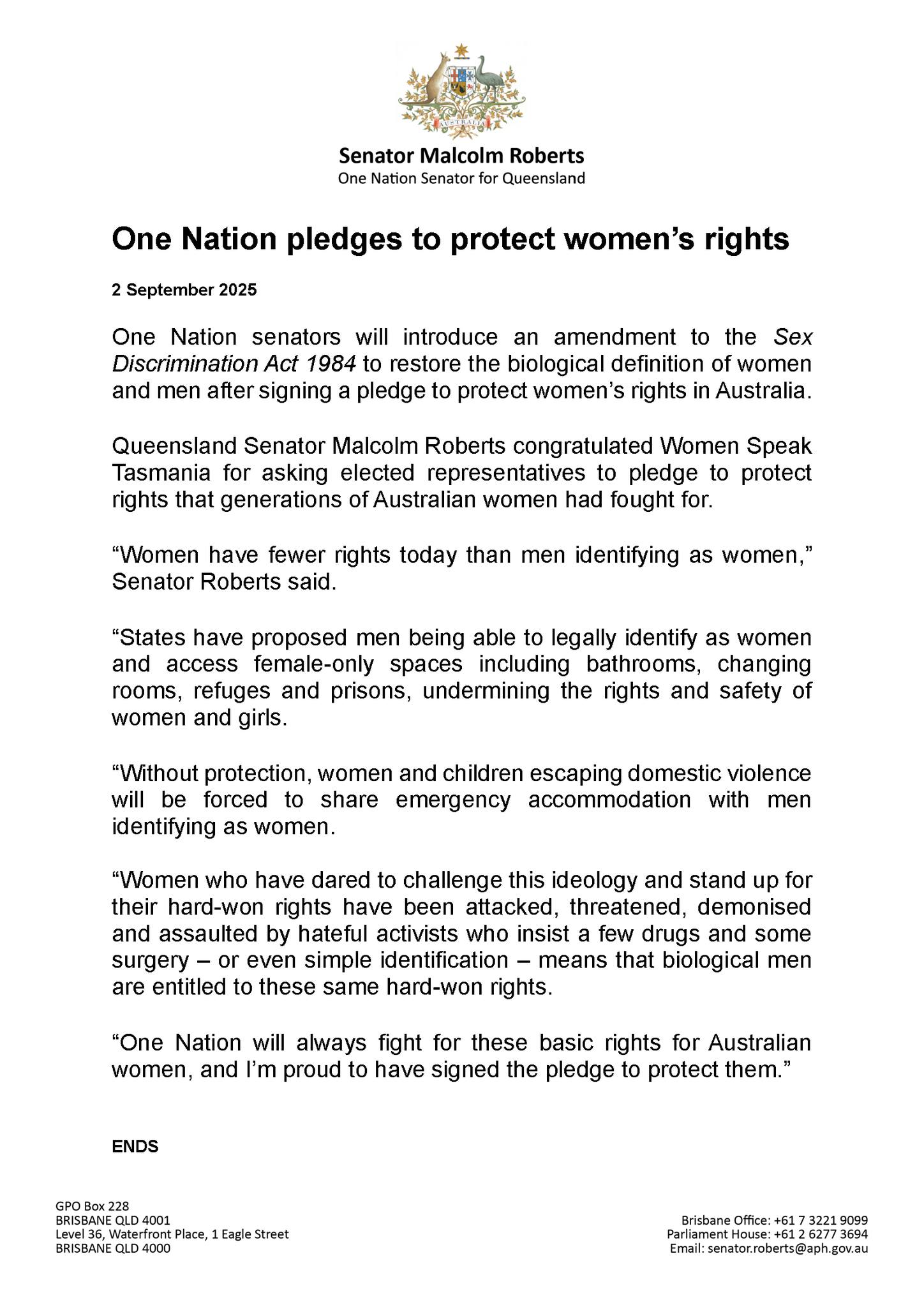
On Tuesday morning, 2 September, One Nation senators signed a pledge to protect women’s rights.

Identifying as a women can’t mean biological women suddenly have their rights taken away from them.

One Nation is the only party who isn’t afraid to define what a woman is.

New South Wales State MP Alex Greenwich has introduced two horrific anti-human bills in the NSW parliament. These bills are so bad I had to raise my concerns in a Senate speech.

In 2023 women are becoming simultaneously invisible and exploited. Women’s rights are being removed by the Left under the cover of ‘inclusive’ gender diversity and a ‘progressive’ facade. This attack on femininity is taking the women’s movement backwards, which will come at a terrible cost to our society. When public figures are too cowardly to even define what is a woman, society is in trouble.

In a nutshell, Alex Greenwich proposes legalising sex self-id, making official documents reflect the individual’s self-image rather than biological reality. This undermines the safety of women and girls in female only spaces. He also seeks to fully deregulate prostitution, removing protections for all prostituted persons.

In a bid to make it easier for the gay community to become parents, Alex Greenwich’s proposed bill also seeks to remove bans on commercial surrogacy if it happens outside NSW. Although it’s an understandable goal for gay couples to parent a child, this would make it legal for NSW residents to use foreign baby farms.

Such a bill would encourage the exploitation of poor, vulnerable women. It reduces them to the status of a womb for rent and turns children into products for sale. We’re living through the beginnings of a modern day handmaid’s tale. Bills such as these would remove many of the protections in law women have worked so hard to achieve.

This attack on women’s rights is also an attack on society’s values and religious freedoms. The final thing this bill seeks to introduce is that religious belief will no longer be an acceptable employment criteria for religious schools. If someone from the LGBTIQA+ community wanted to infiltrate a religious school then woe betide that school for turning them down. It’s clear that those responsible for the moral decay of society see Christianity as the resistance and want it destroyed from within.

Transcript

As a servant to the many different people who make up our one Queensland community, I draw the Senate’s attention to the New South Wales parliament, where independent MP Alex Greenwich introduced two bills, the Equality Legislation Amendment (LGBTIQA+) Bill 2023 and the Conversion Practices Prohibition Bill 2023. Both bills are anti-women and anti-children. The proposed changes include, firstly, introduction of sex self-ID, allowing anyone to change their legal sex on official documents such as driver’s licence and birth certificate. These documents will no longer represent physical reality; they will show mental self-image. Men will be able to legally identify as women and access female-only spaces including bathrooms, changing rooms, refuges and prisons, undermining the rights and safety of women and girls. Women and children escaping domestic violence will be forced to share emergency accommodation with men. Imagine the additional trauma this will create. A recent Victorian event in Dame Phyllis Frost Correctional Centre shows the danger of these laws. A biological man convicted of violent assaults against women was transferred into a female prison. Female prisoners unsuccessfully petitioned to remove him. A wider public campaign raged for weeks before the transfer was eventually reversed.

Many women in jail have suffered abuse from men that lowers women’s self-esteem and then they go on to drug abuse, crime and illegal behaviour. To TIGA+ campaigners, the mental and physical effect on female inmates from having men in with women seems irrelevant. It appears that many in the TIQA+ community believe women are only to have rights that do not compromise men’s rights.

Secondly, fully deregulated prostitution will remove protections for prostituted persons, mostly women, as well as the wider community. While many may enter this line of work willingly, prostitution is the world’s oldest form of slavery and exploitation. To remove penalty based regulation is an insane idea that will remove the rights of exploited women to enjoy the protection of law. This is despite the global movement to combat, not foster, this abhorrent form of sexual exploitation, violently making women’s bodies commodities.

Thirdly, removing bans on commercial surrogacy if it takes place outside New South Wales, legalising the actions of New South Wales residents using foreign baby farms. This bill will encourage the exploitation and commodification of vulnerable women who will be reduced to the status of a womb for rent, and children reduced to products for sale. This is a modern-day form of human trafficking that’s broadly opposed among human rights defenders. I understand that the homosexual community want to parent a child, and the research on this issue is generally supportive. Yet allowing poor women in Third World countries to be exploited for the benefit of gay couples in the West is an outrage. Women are more than just uterus owners and chest feeders. Women have the right to be protected from exploitation, not to have exploitation enshrined in law.

Fourthly, this bill removes religious protections in current antidiscrimination laws. It will be illegal for religious schools to discriminate against an LGBTIQA+ person, allowing an openly trans person to apply for employment and to prevent discrimination against their employment. Religious belief will no longer be an acceptable employment criteria for religious schools. It seems that people responsible for society’s moral decay see Christianity as resisting that moral decay and therefore they want to destroy Christianity.

Turning to the second bill, the Conversion Practices Prohibition Bill 2023, this bill criminalises medical professionals and parents trying to help those suffering with gender dysphoria in a way that doesn’t simply affirm a person’s gender identity. As one constituent, a qualified psychologist, said to me recently, ‘If a child presents to me believing they are a giraffe, I must treat them as though they are a giraffe.’ In the TIQA+ world, this masquerades at health care. This bill ignores mounting medical evidence that the affirmation-only approach is causing gender dysphoria, harming children through irreversible medical transitioning leading to shattered lives filled with regret, regrets the 7NEWS Spotlight show brought to mainstream Australia last Sunday.

Women’s Forum Australia has launched a campaign to protect women, children and our community from these harmful measures. One Nation supports that campaign. Every person deserves respect, equality and care under our laws. Alex Greenwich’s measures are counterproductive to these principles. In 2023, women are becoming invisible handmaidens, servants, with their identity as women being taken from them. One Nation stands opposed to this antihuman agenda. (Time expired)

I remember the feminist protests of the seventies, when women marched behind banners that read, ‘If you see my gender, you do not see me.’

Now the gender radical trans-activists have transformed that slogan to read, ‘You will see my gender, or else!’

This is not progress; this is division wrapped in a multicoloured bow.

Transcript

As a servant to the many different people who make up our one amazing Queensland community, I’m a representative for all Australians, including those with an XY chromosome and those with an XX chromosome—a servant of men and women and those adults who choose to live as something other than their chromosome provides.

Today, this Parliament House saw an exercise in democracy of which I’m very proud. The Let Women Speak rally on the lawn outside was conducted with a restraint that was sadly lacking in Belfield. I applaud the commitment to decent behaviour from those who attended to protest in favour of women’s rights and those who attended to redefine women’s rights, and I thank the AFP for their calm presence.

As senators, we have an obligation to pour oil on troubled waters, not pour kerosene on a fire. Yesterday, Senator McKim described our fellow Australians who choose to protest in favour of women’s rights as ‘trans-exclusionary, right-wing dropkicks—T-E-R-D-S’. It is not a defence for the senator that this actually spells t-e-r-w-d. Just because he can, that does not mean we should address constituents in such terms.

I remember the feminist protests of the seventies, when women marched behind banners that read, ‘If you see my gender, you do not see me.’ Gay rights campaigners, back when there was something to campaign for, marched behind banners that read, ‘If you see my sexuality, you don’t see me.’ In 2023, one group within our community has transformed that slogan to read, ‘You will see my gender, or else!’ This is not progress; this is division wrapped in a multicoloured bow.

In the years ahead, our society will be greeted with many challenges, social, economic and defence. We must face these challenges together, accepting our differences. The one thing that forces trying to reshape Australia fear the most is our unity: Australians facing our challenges united behind one flag, as one community and one nation.

Let women speak!