A report revealed from a motion I put into the Senate, that the government kept a helicopter flying for more than 5 years with a defective engine part.
That MRH-90 helicopter that crashed in Jervis Bay without any fatalities was a stroke of luck. Four months later, another helicopter crashed in the Whitsundays, resulting in the death of four Defence personnel. This report reveals that senior “leadership” of Defence was willing to put people’s lives at risk with defective engine parts. The question must be asked – how many other risks were they willing to overlook or explain away?
One Nation backs our Defence Personnel. The Government can’t claim they do unless they hold senior members of the Defence Department accountable for their failures.
Transcript
I rise to speak on the document produced in response to order for the production of documents No. 200. This order relates to the MRH-90 Taipan helicopter crash in Jervis Bay in May 2023. The helicopter call sign Bushman 82 was hovering low to water on a training exercise, with divers suspended below, when it experienced a catastrophic failure of its left-hand engine. The helicopter ditched into the water—in a stroke of luck, without any fatalities. Just one month later, Defence gave the MRH-90 helicopter a completely clean bill of health and authorised it to continue flying. The Senate agreed to this OPD in May 2023, requiring Defence to hand over any safety reports and documents in relation to the crash. We wanted to know how Defence had certified the helicopter as safe so quickly after such a significant incident. In defiance of the order of this Senate, the Minister for Defence refused to hand over any documents, citing an ongoing internal investigation, despite the helicopter already being back in the air, threatening lives. The government and Defence advised that that investigation should conclude in October 2023.
In June 2023, a month after, the Senate reiterated its order for the documents in motion 243, with a new deadline of November in accordance with the advice of the government. We gave them a go. They failed to produce even a response to that order until the Senate sought an explanation in December of 2023. We can see how time marches on and is irrelevant to Defence.
Now we fast forward to September 2024, 18 months after the crash and nearly a year after the government promised to respond. We finally have a response and documents, yet it is not a compliant response. It’s a redacted version of an executive summary to a single report. The order very clearly specified ‘all incident reports, safety evaluations, briefing notes, correspondence and information held by the Department of Defence, the defence minister or the defence minister’s office’. The executive summary to one report clearly doesn’t satisfy this request.
Minister, where are your briefing notes? Where is your correspondence? Are you telling the Senate that you and your office had nothing to say about the Jervis Bay ditching? The executive summary is dated 2 August 2024. That’s three months and two weeks ago. Did Defence sit on this report before giving it to the minister? Why the delay? The six pages of redacted executive summary we do have are from the Defence Flight Safety Bureau’s aviation safety investigation report. From what we do have, a few things are clear:
The engine failure was caused by the rupture of Blade 34 from the High Pressure 1 (HP1) wheel in the High Pressure Turbine (HPT).
They know the cause. Another quote reads:
… in 2017, as a result of several HP1 failures across the global fleet, the Original Equipment Manufacturer (OEM) issued a NH90 Service Bulletin recommending that operators … replace HP 1 blades with modified blades.
Another quote reads:
The investigation highlighted that there was no definitive evidence of the completion and recording of hazard analysis and safety risk assessments related to HP 1 failures during MRH-90 PCS operations.
Defence decided to keep flying the helicopters without the modified parts and eventually get around to it while failing to consider and document the risk that these things would lose an engine during low-level flight because of this. In 2023, five years after the bulletin was given to Defence, Bushman 82 was still flying in Jervis Bay, without the recommended modified parts.
This report, while not compliant with the Senate’s order, is important because it again demonstrates Defence was willing to overlook serious risks when it came to this helicopter—risks involving lives. How many other problems with the MRH-90 helicopter did Defence overlook? How many times did they allow this thing back in the air, knowing it would unnecessarily put our defence personnel at needless risk? How many potentially catastrophic issues, like the TopOwl headset, were supposedly mitigated or did Defence just explain away?
These documents are important because this helicopter should have been pulled from service a decade ago. The MRH-90 should have been permanently grounded after Bushman 82 ditched into Jervis Bay—the latest, at the time, of a series of incidents. It wasn’t pulled from service, and, four months later, Bushman 83 crashed in the Whitsundays, resulting in the death of four personnel: Warrant Officer Class 2 Joseph Phillip Laycock—Phil, as he was known; troop commander Captain Danniel Lyon; Lieutenant Maxwell Nugent; and Corporal Alexander Naggs. May they rest in peace. Blood is on the hands of the Defence leadership and successive defence ministers who kept this helicopter in the air when it belonged on the ground. I seek leave to continue my remarks later.
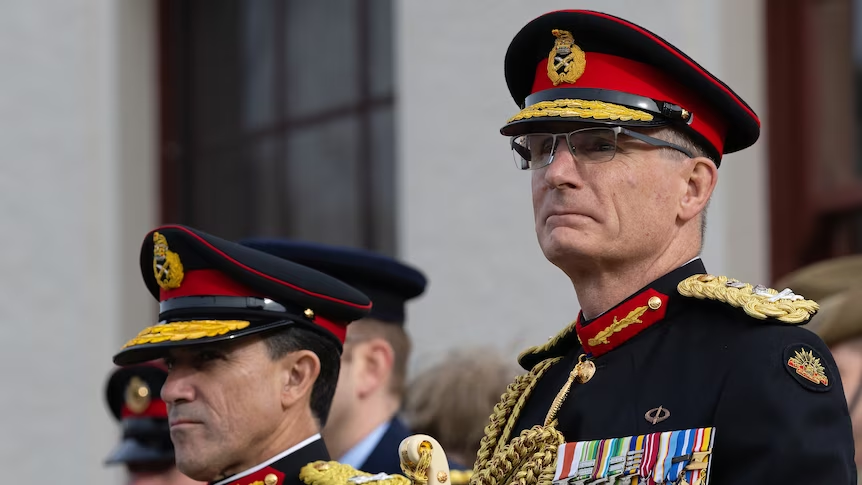
One day after the anniversary of 9/11 and three days after the Royal Commission into Defence and Veterans Suicide, the government has decided to strip medals from some junior and mid level officers over war crime allegations in the Brereton Report. Despite this, the former Chief of the Defence Force, Angus Campbell, is wearing a medal for commanding those same people he has said should be stripped of their medals.
Accountability starts at the top. Defence Minister Richard Marles stands condemned for his decision and its timing.
Transcript
My question is to the Minister representing the Minister for Defence, Senator Wong. Minister, on the recommendation of the then Chief of the Defence Force General Angus Campbell, the government will strip distinguished service medals from soldiers for allegations of war crimes that have not been proven in a criminal court, yet the government will not strip the Distinguished Service Cross medal off General Campbell. Minister, why do soldiers under General Campbell ‘s command lose medals while he keeps his medal for commanding them?
Senator WONG: I thank the senator for his question. Senator Roberts, as the Deputy Prime Minister has stated to the House of Representatives today, we finalised our commitment to close out the recommendations of the Inspector-General of the Australian Defence Force Afghanistan inquiry report, known as the Brereton report, which was commissioned in 2016. The report found credible information of alleged unlawful killings of 39 individuals in 23 separate incidents. Further, there was credible information of a subculture of elitism and deviation from acceptable standards. It made a broad range of findings and 143 recommendations. As the Deputy Prime Minister has outlined, we have taken final action as a consequence of that report resulting in the closure of 139 of these recommendations.
Two recommendations of the report related to command accountability and the treatment of honours and awards given to commanders during the relevant period. These recommendations relate to a small number of individuals who held command positions during the period in which the inquiry found evidence of unlawful conduct. The Deputy Prime Minister has written to—
The PRESIDENT: Senator Roberts?
Senator Roberts: President, on a point of order: the question was very specific about Angus Campbell’s Distinguished Service Cross. Why won’t it be stripped?
The PRESIDENT: The minister is being relevant to your question, Senator Roberts. Minister, please continue.
Senator WONG: Senator Roberts, I was seeking to respond by way of explaining how we are dealing with the recommendations of the report which relate to command accountability. I understand that the Minister for Defence, the DPM, has written to those whose awards were referred for consideration to advise that there has been a conclusion to that consideration of those awards. Decisions that have been made in relation to those awards are consistent with the findings and recommendations of the Brereton report. Decisions around command accountability are consistent with those same findings. Obviously we’re not in a position, given the Privacy Act, to disclose the details— (Time expired)
The PRESIDENT: Senator Roberts, a first supplementary?
Minister, the Brereton report specifically excluded any findings on command accountability. The implementation oversight panel, though, provided independent advice to government that the Brereton report, in doing this, was inappropriate and that senior command accountability must be examined. Why are Defence’s most senior leaders being let off scot-free on allegations in the Brereton report and why is your government ignoring the oversight panel’s advice?
Senator WONG: I will see if I can get any further information to respond to the assertion in relation to the panel because I don’t recall the facts being quite as you assert them, Senator Roberts, but it isn’t in my portfolio and so I will certainly have a look at that. But, as I read out in my primary response, two of the recommendations of the Brereton report did relate to command accountability and the treatment of honours and awards given to commanders during the relevant period. There was an alternative assertion in your question, and that is not the advice to me. We have acted on the basis of and in a manner consistent with those recommendations.
The PRESIDENT: Senator Roberts, a second supplementary?
Senator ROBERTS: Minister, the criterion for the Distinguished Service Cross at the time General Campbell was nominated required him to be ‘in action’, meaning in direct contact with an enemy, yet there are no records of General Campbell being in action. Why does your government refuse to have the honours and awards appeals tribunal examine his award?
Senator WONG: Senator Roberts, I think that is a slightly different question to the one you asked me, which related to the Brereton report. In relation to the actual awarding of those honours, that’s obviously not a political decision but a decision that is governed within that honours and awards system. I would make the point that these matters have been canvassed at length by, I think, Senator Lambie in a number of estimates, and I’d refer you to those answers, including direct answers—to my recollection, including before the change of government—from General Campbell himself.
There is no specific evidence that Angus Campbell was “in action” which is the criteria required for his medal at the time of his nomination.
The honours and awards system has been abused, with senior officers and generals giving medals to each other, while frontline soldiers who faced direct enemy fire must fight yet again, this time for the recognition they rightfully deserve.
This issue goes far deeper than General Campbell. It’s time to clean out all the rot at the highest levels of the Defence Force.
A powerful Senate Inquiry established into the Defence medals system has opened for submissions.
The inquiry initiated by my motion will investigate potentially illegal medals awarded to senior Defence officers, the experiences of ADF personnel and potential improvements to the Defence Awards and Honours system.
I joined Peter Fegan of 4BC Radio to discuss the inquiry into the defence honours and awards system due to my motion being passed in the Senate recently.
The morale within the ADF is alarmingly low, reaching a level that could severely impact our future security.
There is a prevailing sentiment among ADF personnel that the senior leaders are not accountable. The top brass are abandoning enlisted members and veterans, while taking credit for achievements that aren’t rightfully theirs.
On 29 June, protestors vandalised War Memorials in Canberra. These disgusting acts must be condemned.
Freedom of speech and protest are fundamental parts of our democracy. Spray painting memorials of dead soldiers is neither of these.
I joined with Senators Lambie and Hanson in strongly condemning the defacement of war memorials by pro-palestinian protestors, which insults both current and former Australian Defence Force personnel and disrespects the memorials’ significance as national symbols of pride and remembrance.
This divisive campaign by the Greens undermines Australia’s respect for our defence forces and reflects an anti-Australian agenda. Vandalism of these memorials is an affront to our country’s values and those who serve to protect them.
We stand in solidarity with service men and women, their families, and all Australians who honour their sacrifice.
Transcript
One Nation supports this motion, and I’ll read it again:
That the Senate condemns the act of defacing war memorials by pro-Palestinian protestors which is deeply insulting for current and former members of the Australian Defence Force and undermines the significance of these memorials as symbols of national pride and remembrance.
It undermines the very core and heart of our beautiful country, and the Australian people. It undermines the respect we have, as a nation and as individuals, for the service of so many caring Australians in our defence forces, past and present, and it reveals the pro-Palestinian protesters’ true, anti-Australian agenda. I join with Senator Lambie and Senator Hanson in condemning the Greens for this divisive campaign that they are pushing based on ideology and harvesting votes. It is essentially treason—defacing and desecrating our country and what we stand for. Australians, whatever their views of the wars we’ve engaged in, take pride in and honour our service men and women.
I recall a friend of mine; when we were in our 20s, he made the off-the-cuff comment that he despised the War Memorial because it was a memorial to the glory of war. I said: ‘No, no. It’s not. It’s a memorial to the service that men and women have given in supporting and defending this country and what we stand for.’ He has gone on to be a proud grandfather, with two boys now serving in the Army and a daughter serving in the police force of Queensland. He has children and grandchildren who have served and are serving our country.
Free speech, as Senator Cash pointed out, is not vandalism and desecration, which is the violation of property rights and must be punished. To all service men and women and their families and relatives: thank you. We will vote in favour of this motion to condemn the acts of defacing war memorials in your name.
It was a pleasure to have a long chat with two fantastic veterans, Dylan Conway from the charity Brothers and Books and Michael Lorrigan of Two 14 Coffee Company, to talk all things Defence and Veterans
You won’t want to miss the incredible story of what these gentlemen are doing for the Australian community.
https://img.youtube.com/vi/JRzTv3Htlik/maxresdefault.jpg7201280Senator Malcolm Robertshttps://www.malcolmrobertsqld.com.au/wp-content/uploads/2020/04/One-Nation-Logo1-300x150.pngSenator Malcolm Roberts2024-07-12 14:17:522024-07-12 14:17:57Supporting Our Heroes: A Long Chat with Dylan Conway and Michael Lorrigan
It was a pleasure to have a long chat with two fantastic veterans – Dylan Conway from the charity, Brothers and Books and Michael Lorrigan of Two 14 Coffee Company – to talk all things Defence and Veterans.
Brothers and Books does fantastic work supporting reading therapy for first responders, with companies like Two 14 Coffee backing them up.
You won’t want to miss the incredible story of what these gentlemen are doing for the Australian community.
https://img.youtube.com/vi/JRzTv3Htlik/maxresdefault.jpg7201280Senator Malcolm Robertshttps://www.malcolmrobertsqld.com.au/wp-content/uploads/2020/04/One-Nation-Logo1-300x150.pngSenator Malcolm Roberts2024-07-04 10:18:242024-07-04 13:22:09Supporting Our Heroes: A Long Chat with Dylan Conway and Michael Lorrigan
I asked the Inspector General of the Australian Defence Force (IGADF) about some decisions from Defence that I believe warrant investigation.
I was under the impression that the IGADF would have some jurisdiction over complaints if Defence bureaucrats had a perceived conflict of interest.
In this session, they seem to wash their hands of all responsibility of inspecting this potential breach of integrity. Could it be something to do with the fact that the document in question was critical of the Brereton Report, which the IGADF created?
I will continue to make sure soldiers are given due process and generals are made accountable. If anyone is going to be put in jail for war crimes, the first ones locked up should be the politicians and generals that sent our men there.
Transcript
Senator ROBERTS: Thank you, Mr Gaynor, for being here. I understand you’ve received a complaint in relation to the decision-maker on Defence freedom of information application 577/23/24. Are you in a position to confirm that you have received that and you’re processing it?
Mr Gaynor: No, I can’t answer that question, because I don’t understand which case it might relate to with just that number, but I can take that question on notice.
Senator ROBERTS: Thank you very much. Catherine Wallis was the person who decided to block the release of the Afghanistan Inquiry Implementation Oversight Panel report. She is the Director-General of the Afghanistan Inquiry Response Task Force. The panel report is highly critical of the taskforce Catherine Wallis leads. I must say that the defence department pulled out some quotes that were favourable to Ms Wallis or to the oversight panel, but there are many, many other quotes that Defence neglected. So the panel report is highly critical of the task force Catherine Wallis leads, and she’s the decision-maker on whether to release that report under freedom of information. On the face of it, that would be a conflict of interest that you would be able to investigate, wouldn’t it?
Mr Gaynor: These questions would be better directed to the Afghanistan Inquiry Response Task Force or to the Department of Defence. If freedom of information application 577 refers to a freedom of information application for the oversight panel’s report, then my office has had nothing to do with that report or with that freedom of information application. The role of my office is principally threefold. It’s an integrity, inquiry and assurance agency. My statutory role is to examine failures in the military justice system, to inquire into the deaths of ADF members where those deaths appear to have arisen out of or in the course of their service, and also to superintend the statutory Redress of Grievance complaints scheme, which is available for all ADF members.
Senator ROBERTS: Thank you for your response. It would seem to me that under the first one, ‘integrity’ and ‘inquiry’, this would be perfectly placed, because there appears to be a massive conflict of interest with Ms Wallis signing off and, in fact, signing off on a previous FOI application but not signing off on this one.
Mr Gaynor: Yes. I say ‘yes’ not to indicate agreement, but I understand your question. But my role is to examine matters affecting the military justice system. What you’re talking about here is an administrative decision that’s been made under the FOI Act. There are other ways of seeking review of such decisions, both internal and external to the Department of Defence.
Senator ROBERTS: Do you have any information on why Catherine Wallis deleted her position title on the taskforce from her signature on this decision, despite including it on a different decision only days earlier?
Mr Gaynor: My office conducted the IGADF Afghanistan inquiry. We delivered the report to the Chief of the Defence Force in November 2020. Noting that my office is an independent statutory office within the Defence portfolio that’s otherwise separate from the administrative functions and the department’s functions, I don’t have any visibility or oversight of freedom-of-information decisions that are made within the Department of Defence.
Senator ROBERTS: With your familiarity with the Defence systems, presumed on my part, I’m wondering how someone with such a conflict of interest could be allowed to make the decision of blocking the release of the report which is critical of her work. Could you tell me who you think would be the best avenue for us to go to?
Mr Gaynor: No, Senator, I genuinely cannot. There would be an official within the department who is responsible for freedom of information, but I don’t know who that individual is. Freedom-of-information decisions that are received by my office are made within my office. I don’t have visibility of the department’s decision-making.
Senator ROBERTS: Your duties as inspector-general don’t cover scrutiny of freedom of information from Defence?
https://img.youtube.com/vi/fBPxA_SMC_k/maxresdefault.jpg7201280Senator Malcolm Robertshttps://www.malcolmrobertsqld.com.au/wp-content/uploads/2020/04/One-Nation-Logo1-300x150.pngSenator Malcolm Roberts2024-06-10 15:37:112024-06-26 12:30:13Who Will Hold the Department of Defence Accountable?
General Angus Campbell will retire as Chief of the Defence Force in just a month, leaving behind a mess of morale and military disasters.
Under his watch our special forces have been decimated, morale has been destroyed, the navy is facing the worst outlook in 50 years, the entire force is in a recruiting crisis and he refuses to accept responsibility for what happened, all while wearing medals for “distinguished command and leadership” and earning $1 million a year.
On behalf of the many soldiers, sailors and aviators that have contacted me over many years, farewell General Campbell – you do not go with our thanks and you will not be missed.
Transcript
Senator ROBERTS: Thank you for appearing again, General Campbell. Looking at the Afghanistan Inquiry Implementation Oversight Panel report, Defence tried to keep this report secret, blocking freedom of information requests. It was only when the Senate, on my motion, ordered it to be produced that we’ve seen it. In my opinion, General Campbell, we can see why you wanted to keep this a secret, given what it said about your response to the Brereton inquiry. I’m going to read quite extensive quotes from it. It’s important to have this information on the record, given your previous denial of command responsibility. Quote:
Looking through an organisational lens, the assessment of accountability and responsibility starts at the top. More senior officers have to take some level of responsibility for what goes wrong in their organisation or at least for any circumstances or policies that permitted or facilitated it. If no-one at an appropriate level of authority knew anything about this misconduct, that is an organisational failure in itself.
Next quote:
The Panel considers that the failure to look closely at the collective accountability and responsibility of Defence’s most senior leaders continues to generate resentment and anger amongst veterans, soldiers and their families which is likely to last for a long time.
I can vouch for that. We’ve had many servicemen, current and former, contact us. Next quote:
… it is a misuse of their [Special Forces’] capability to employ them on a long term basis to conduct what are essentially conventional military operations.
Next quote:
The history and legacy of former Special Forces members is unjustifiably tarnished.
That’s by the Brereton report. General Campbell, you have refused to accept command responsibility or accountability for allegations, despite wearing a medal for your command. You are a senior officer, at one point commander of all forces in the Middle East. Will you ever take responsibility for your organisational responsibility, instead of just throwing loyal soldiers under the bus?
Gen. Campbell: Thank you, Senator. Let’s start at the beginning of your comments. You’re incorrect to suggest that in some way I or Defence attempted to withhold the oversight panel’s final report to the minister. The oversight panel had, throughout its duties, access to an unredacted view of the Brereton report. That meant that its work needed to be referred to the Office of the Special Investigator to ensure that, in their work, there were no concerns by that office that anything in their report might in any way impinge upon their investigations and considerations for the potential for further legal action. Once that was done, the report was able to be provided to the minister with confidence that the Office of the Special Investigator had no concerns for its public release, and the report was publicly released. So I guess that’s conspiracy No. 1 out of the way. With regard to command accountability—
Senator ROBERTS: With due respect, General—
CHAIR: Senator, let the witness finish their answer first, and then you’ll have an opportunity to ask a followup question.
Gen. Campbell: With regard to command accountability, as has previously been given in testimony here by me and a number of my colleagues, the consideration of command accountability has been developed and completed at the level of Defence and my responsibilities and has been passed to the minister for his consideration. That remains under consideration by the minister and, in due course, the minister will advise of decisions in that regard. The oversight panel’s report was very much appreciated and well received by Defence. It has reflected on the experience and provides some very useful insights into the events that occurred, the manner of its response and the efforts we have gone to in reform and in delivery of now 139 of the 143 recommendations of the Brereton inquiry. Thank you.
Senator ROBERTS: Thank you. Minister, given what General Campbell said, why did the government withhold that document, withhold senators access to that document, the oversight report?
Senator McAllister: As has already been indicated to you, it was necessary to seek advice from the Office of the Special Investigator as to whether or not the release of that report would in any way compromise their work. When that advice was received, the material was provided to the Senate.
Senator ROBERTS: Thank you. General, you’re still wearing bars on your chest and the Distinguished Service Cross that you claim for either being in action, which you never were, or for your command of troops in the Middle East. You’ve previously tried to strip 3,000 soldiers of their citation. You’re still trying to strip other soldiers of their medals. Why do you get to keep Afghanistan medals while you try to have them stripped from soldiers?
Gen. Campbell: I make no claims with regard to the Distinguished Service Cross, which was awarded to me for service in Afghanistan and the Middle East more generally.
Senator ROBERTS: Okay. I just want to close the chapter on your responses to my questions in the past about the search and rescue operation of the MRH90 Taipan crash in the Whitsundays. You’ll recall I first asked about this in October. We had an exchange in February about whether the answers were satisfactory. Missing from the information you gave me was that, after the crash, around 11 pm, HMAS Adelaide continued to sail in the opposite direction towards a photoshoot 140 nautical miles away. When I produced a photo that the Defence Force deleted from the website, General Campbell and Vice Admiral Hammond tried to tell me that HMAS Adelaide would be unable to help due to its size and too many vessels already at the search and rescue. You eventually later clarified that it actually was tasked to do the search and rescue. Why did you delete the images of the photoshoot from your website? Why have we gone through this back and forth for eight months now? Was it just too embarrassing for you to admit that you let a useful boat with helicopters on board sail away to a photoshoot instead of immediately helping with the search and rescue mission when it was assumed those men were still alive?
Gen. Campbell: Thanks, Senator. I’ll have to take the bulk of your question on notice. With regard to the photoshoot, I neither directed nor have knowledge of the claim you’re making that photographs were deleted from the Defence website. I will need to take that on notice to understand whether or not and under what circumstances any photographs were or may have been removed.
Senator ROBERTS: Thank you for that. I’m happy to have that taken on notice. What about the circumstances around the deployment of Adelaide.
Gen. Campbell: Yes; I’ll take that on notice, Senator.
Senator ROBERTS: Thank you. On to your combined special forces selection process, reports from the ground indicate, from 270 candidates, only 13 per cent, or 37, were selected for all special forces groups. Is it time to admit this ridiculous idea of yours, that the troops don’t like, for combined selection has been a massive failure at the expense of millions of dollars with worse outcomes?
Gen. Campbell: Thank you again, Senator. I’d like to correct the record. You speak of it as my ‘ridiculous idea’. It is a well thought out approach being developed by the Army. I don’t lay claim to it, Senator. In terms of the outcomes of it, I would refer to the Chief of Army.
Lt Gen. Stuart: Senator, could I just confirm what your specific question is.
Senator ROBERTS: On your combined special forces selection process, reports from the ground indicate, from 270 candidates, only 13 per cent, or 37, were selected for all special forces groups and you’re having trouble recruiting for the special forces groups—you’re having trouble recruiting for the Army in general. Is it time to admit that this is a failure? The troops are telling us it is.
Lt Gen. Stuart: That may be someone’s characterisation; that’s not our experience. It’s true that there are high attrition rates in any special forces selection. That’s a characteristic. What we’re much better at doing now is understanding the reasons for that. The preliminary assessment that I received just last week on one of the key contributing factors was the physical preparation. We need to lean in and help our people to follow the physical preparation to give them the best chance of completing successfully or not being withdrawn at our own request because they can’t meet a particular physical standard. Of course, there is a whole range of other aspects for assessment as well. So, yes, you’re correct in terms of the low numbers that were selected. That was characteristic when there were separate selection courses. This was the first of the common selection courses. We’re going through an after action review process now to understand what worked, what didn’t work and how we need to adapt it in the future. If I can just add a final point: the reason why we’re doing this goes to some of the points that were in the independent oversight panel’s report to the Deputy Prime Minister that you referred to in your earlier questioning. It’s to address some of the outcomes that we’ve been working on for the last 10 years in terms of the findings from the Brereton inquiry, and, in particular, role clarity among units and also making sure that we have good working relationships between the units in the command.
Senator ROBERTS: The Chair is giving me the wind-up. You’re not lowering standards? You’re just giving soldiers an opportunity to meet the standards?
Lt Gen. Stuart: No; they’re quite high standards, as you’d appreciate.
Senator ROBERTS: But your response is not to drop standards; your response is to help soldiers meet the high standards.
Lt Gen. Stuart: Yes. That is the approach right across the board, not just for special forces selection. So for anybody who puts their hand up for special forces selection—whether that’s as an operator, an integrator or an enabler—they have a thing called a special forces entry test which tests a whole range of things, including some physical standards. To set those people up for success, we’ve provided them with a physical training preparation program that is specifically designed to ensure that they can have the best chance of meeting the standards that are required in that Special Forces Entry Test.
Senator ROBERTS: Minister, what we’ve seen recently under General Campbell’s command is that the SAS regiment has been decimated, with huge numbers of discharges after it was thrown under the bus. The combined special forces selection has been an abysmal failure, according to troops we’ve listened to. The MRH90 helicopter was kept flying until four men were killed in a crash. General Campbell is wearing a Distinguished Service Cross, which is probably illegal from what we’ve highlighted in previous estimates. The OSI has spent $100 million to lay a single war crimes charge, and there were no convictions. The force is in a recruitment crisis, going backwards. We’re 5,000 personnel under strength. The Navy will have the least capable surface leaders it’s had in more than 50 years for the next 10 years. What will you do to restore defence capability?
Senator McAllister: Senator Roberts, there are so many misinformed statements in that question that it’s hard to know where to begin. Perhaps I can say that there is very little of your characterisation of the current state of things that I accept. But I will tell you what it is that we are doing. This institution was subjected to a circumstance where there were many, many defence ministers on and off during the last government. There was chaos and dysfunction, and we are working to resolve that. We are taking defence seriously, unlike the coalition. We will see spending in defence reach 2.3 per cent of GDP over the next decade beyond the trajectory that we inherited. We’re investing $330 billion through the new Integrated Investment Program. We are developing a comprehensive workforce strategy to improve recruitment and retention. We have put in place the pathway to acquire nuclear-powered submarines. We are buying the guided weapons that we need to hold adversaries at risk. We are investing in the surface fleet. We have handed down the 2024 National Defence Strategy. I understand that, in the period I have represent the government in here, you have consistently come here and levied attacks on senior personnel. I am surprised that that is the approach that you have adopted—to personally attack officials. We are happy to discuss the policy settings and will always answer questions in relation to that. My preference would be that we stick to the policy settings and perhaps refrain, just a little, from the very personal attacks that are too frequently offered towards staff and officials.
https://img.youtube.com/vi/WGQGBoBqBR8/maxresdefault.jpg7201280Senator Malcolm Robertshttps://www.malcolmrobertsqld.com.au/wp-content/uploads/2020/04/One-Nation-Logo1-300x150.pngSenator Malcolm Roberts2024-06-06 10:05:002024-06-26 08:03:54Retiring Defence Chief Campbell Leaves Military in a Mess