

In this session, I raised several concerns regarding the heavy vehicle involved in the 2021 rollover near Townsville, which killed Warrant Officer Class Two Ryan Leslie and Craftsman Brendon Payne.
I asked whether the 45M five-axle heavy recovery vehicle had entered service overweight, causing the axles to sit on the bump stops, thereby restricting axle movement and reducing roadholding. I also noted that the tyres were overloaded, requiring approval to operate at higher loads and pressures.
Furthermore, I stated that there was no evidence the antilock braking and stability systems had been calibrated for the addition of the fifth axle, the higher tyre pressures, or unique Australian road conditions. Finally, I pointed out that the operator manual, which was compiled for more nimble vehicles, contained errors and contradictions regarding safe operating speeds and tyre pressures, and entirely omitted recommendations for Australian unsealed corrugated roads.
Defence officials (including Ms. Quinn and Ms. Kuczma) noted that standard contracts include “fitness-for-purpose” and risk-mitigation clauses. While Defence can theoretically choose to accept deviations in specifications under tight timelines, the DDA will maintain independent authority and accountability to manage contracts, enforce compliance, and withhold payments or suspend programs if requirements or safety standards are not met.
In response to my concern that the fatal vehicle’s flaws have still not been remedied, Defence Secretary Ms. Quinn rejected that the department is not focused on safety. She emphasised that Defence takes loss of life very seriously and continually adapts maintenance, acquisition, and operational processes based on new information.
I’ll be watching for the release of the report from the Commonwealth Director of Public Prosecutions.
Transcript
CHAIR: Senator Roberts.
Senator ROBERTS: Thank you, officers, for appearing again tonight. My question is to the Chief of the Defence Force. On 30 August 2021, a 45M vehicle occupied by Warrant Officer Class Two Ryan Leslie and Craftsman Brendon Payne failed to take a bend on Dotswood Road near Townsville, rolled and killed both occupants. ‘On 29 August 2025, an investigation was opened into the contributing factors in the rollover’—this is a quote—’that caused the deaths of Warrant Officer Class Two Ryan Allan Leslie and Craftsman Brendon Anthony Payne and was due to report by 4 March 2026.’ Has that investigation been completed?
Adm. Johnston: I’ve just been joined by the Chief of Army, who may assist me with those answers.
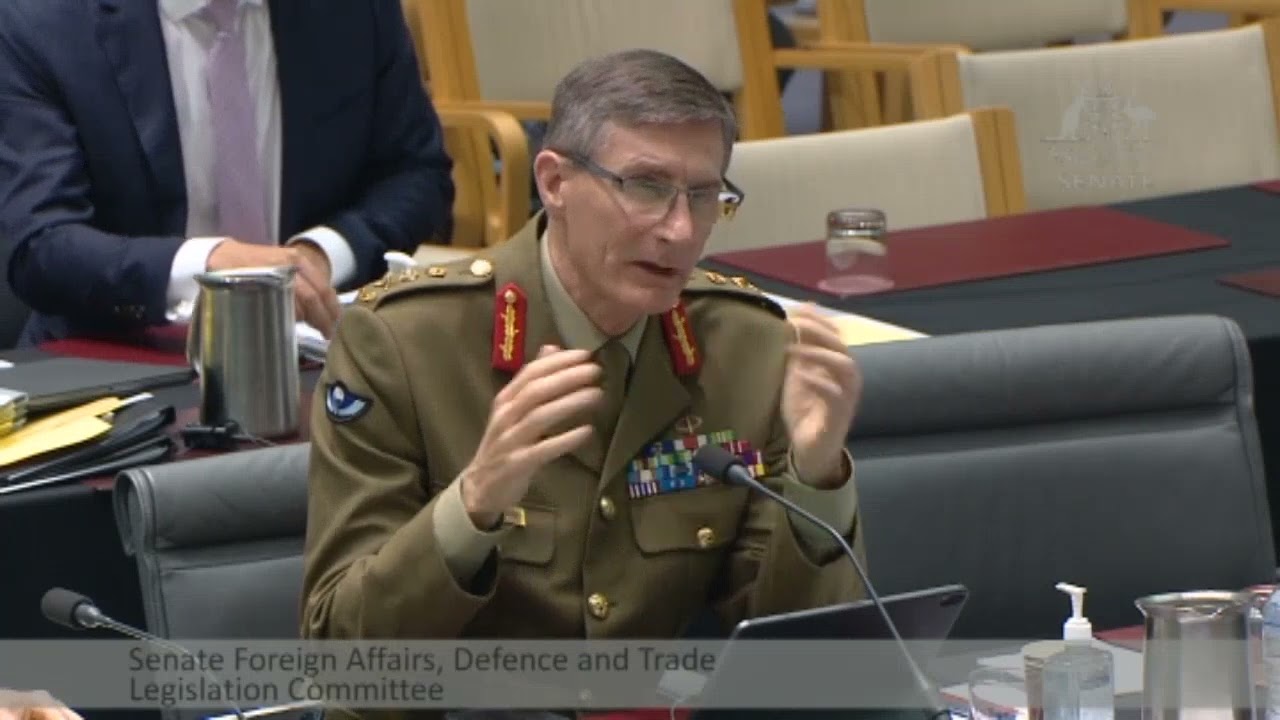
Lt Gen. Stuart: I can confirm that the Defence investigation has been completed and the final report was submitted to Comcare. That investigation was led by the land accident investigation team. That matter is now with the Commonwealth Director of Public Prosecutions. The details of the report—including the findings, recommendations and conclusions—are not available to me during the period of litigation.
Senator ROBERTS: Sorry, did you say ‘not available’?
Lt Gen. Stuart: They’ve been referred to the Commonwealth Director of Public Prosecutions. The details of the report—including the findings, recommendations and conclusions—are not available for dissemination during the litigation that is currently ongoing.
Senator ROBERTS: What are the outcomes of the investigation that you can share with us?
Lt Gen. Stuart: I’m not in a position to share those outcomes with you while they’re subject to litigation.
Senator ROBERTS: Can you confirm my understanding of these vehicles? The 45M five-axle heavy recovery vehicle entered service overweight, resulting in the axles sitting on the bump stops. This restricted axle movement and reduced roadholding. Is that correct?
Lt Gen. Stuart: I’ll have to take that on notice.
Senator ROBERTS: The tyres were overloaded, requiring approval to run at higher loads and pressures. Is that correct?
Lt Gen. Stuart: I have to take that on notice.
Senator ROBERTS: There was no evidence of the calibration of the antilock braking stability systems for the addition of the fifth axle, higher tire pressures and unique Australian road conditions. The operator manual had been compiled for more nimble vehicles, contained errors and contradictions for safe operating speeds and tyre pressures, and did not include recommendations for Australian unsealed corrugated roads. Could you take that on notice, please.
Lt Gen. Stuart: You’re effectively making a series of assertions that may or may not be included as part of the investigation that was undertaken and is currently with the Commonwealth Director of Public Prosecutions.
Senator ROBERTS: That’s what I’ve been advised—some of the design failures or flaws in the vehicle.
Lt Gen. Stuart: Is that a question or a statement?
Senator ROBERTS: Can you confirm that?
Lt Gen. Stuart: As I’ve just advised, the investigation is referred to and currently with the Commonwealth Director of Public Prosecutions.
Senator ROBERTS: What administrative changes have been made to improve safety and compliance of procured capability?
Lt Gen. Stuart: I can speak to a whole range of work that we’ve done. We have what you might describe as a generative safety culture, which is modelled on the way that airworthiness and air safety are managed. That is a proactive culture of reporting and continual improvement. In terms of the detail as to some of the things that we have done, I’ll provide some of the outcomes and then I might throw to my colleague Major General Vagg to provide some more. First, the application of data and analytics—that is, to have systems on the vehicle that are able to provide us with both retrospective and predictive analysis as to driving habits, and, therefore, help us understand the risks. Second, we’ve undertaken a review of the training that we provide for soldiers and other members of the ADF to ensure that it is fit for purpose and that we apply what we have learned from vehicle incidents and accidents. As you might appreciate, we have some soldiers who join the army who may not have even a civilian drivers licence. The kinds of conditions that we need to operate vehicles in, include not only the operation of the vehicle but also its tactical employment, whether that’s by day or night, on formed roads or cross country, in any kind of season, weather or terrain. We’re continually looking to update the way in which we train people to ensure that they can operate safely. In the introduction to service, and even before that, is the selection, testing and validation of any major system vehicle or weapon to ensure that it can be operated safely and that we have properly characterised the risks that may accrue to our people, and that we have either procedural, technical or equipment based mitigations or ways of reducing the risk to our people.
Senator ROBERTS: Have you heard of a man called W. Edwards Deming?
Lt Gen. Stuart: I have.
Senator ROBERTS: You would know, then, that he led the turnaround of the Japanese producing crap to producing the best products in the world.
Lt Gen. Stuart: I’m generally aware of what Mr Deming did.
Senator ROBERTS: He said that as much as people in management like to blame or inherently try to blame people for their problems, 95 per cent of the problem is the system, which only the manager can fix. What administrative changes have been made to improve safety and compliance of procured capability?
Lt Gen. Stuart: I have a couple of points before I’ll hand over to my colleague. Firstly, I’m accountable for everything that happens in the Army and the safety and wellbeing of all our people. Secondly, we operate a whole range of different systems, and in every case we seek to ensure that our people are systemically supported. We have a multifaceted approach to ensuring that equipment is safe, whether it’s technical assessments, predictive analysis, the way in which we train our people, or the assurance of the safety, the maintenance and the supply chain systems. It’s a holistic approach to assuring capability, assuring that those capabilities are fit for purpose, assuring that they are safe for our people to use, and assuring that our people are trained, educated and experienced to ensure that risks are managed so far as is reasonably practical.
Major Gen. Vagg: I’ll reinforce what the Chief said. He is the land worthiness authority. Land worthiness is a system of checks that looks at current, in-service capabilities and also future-looking capabilities that we’re going to introduce into service. We’ve been developing that system over several years now. It had an interim operating capability in March 2020, and we’re on track to achieve a final operating capability in December of this year. That process is backed by a series of assessment tools, such as data trend analysis, that identify high-risk capabilities but also new capabilities, and we form an independent board which interviews users—from soldiers to managers, the procurement agency and other assurance agencies—and validates that the capability is fit to do what we’ve acquired it to do and that it’s fit and safe to operate, as the chief discussed. That board is made up of a series of retired one-star and two-star officers from across the services who have no direct linkage to the capabilities. They have no independent equities or personal equities to that capability. They’ll provide independent advice to the landworthiness authority and a series of recommendations. Those recommendations are then heard through the army operating system and implemented through our capability development and capability management processes.
Senator ROBERTS: My next question is for the deputy secretary of the Capability Acquisition and Sustainment Group, Chris Deeble, or Nadine Williams or both.
Ms Quinn: There are two different activities. There’s the capability acquisition group, for which we have a witness, and then there is the whole-of-government review of the defence delivery mechanism. So, depending on where your questions go, we may have different witnesses.
Senator ROBERTS: Okay. There’s been much discussion and evidence provided to me and the parliament of the knowing approval of defective capability leading to injuries and fatalities. What does the Capability Acquisition and Sustainment Group do?
Ms Kuczma: I think the question is quite broad. Our job is to acquire capability that is fit for its intended purpose and deliver that to the service that requires it.
Senator ROBERTS: Thank you. That’s pretty succinct.
Adm. Johnston: Senator Roberts—sorry to interrupt. I know and recognise your advocacy for the safety of our people. If you do have evidence that suggests that we have not treated safety in the introduction of equipment into service, I would welcome that being provided through our minister so that we can both review that material and come back to you with insights that answer those areas of concern that you have identified.
Senator ROBERTS: Thank you. What actions have been taken in the design of the Defence Delivery Agency to ensure that non-compliant capability is not accepted for service?
Ms Quinn: I’m happy to give a high-level answer. There has been an ongoing review of the acquisition system within the Department of Defence that goes across all phases of the acquisition program, from defining capability to acquiring and sustaining it, and the feedback loops throughout that whole system. In that process, there’s been an identification of some improvements we can make—some structural, some behavioural and some about being clearer on our accountabilities. So they do fall into different categories. One is just being very clear about the accountability for the different elements of those phases of any capability acquisition, development and sustainment. The second is to improve the professionalism of the staff at all three stages of that process. That includes having a specialised workforce, particularly through the Defence Delivery Agency—I keep using the acronym DDA. That’s about professionalising the workforce, working with other elements of the Defence establishment, including industry in particular, to be able to ensure that we can improve the acquisition. Safety, of course, is one of the elements of the process. I’ll pass to Nadine Williams if she’s got anything to add.
Ms Williams: I wouldn’t add much to that. As the secretary has said, the design of the Defence Delivery Agency has considered the matters that she’s raised. We’re going through quite an extensive process of looking at how the Defence Delivery Agency is constructed, how professionalism might be better articulated through that construct and how accountabilities will ensure that there are really clear responsibilities for all elements of acquisition as it’s currently articulated.
Ms Quinn: The concept of contestability in decision-making has been a theme as well. One reason to be very clear about the stages of the process is to ensure there’s very good contestability at the different stages, so that it’s a multidisciplinary view of capability development, acquisition and sustainment. Having more voices, but with clear accountability, will improve the delivery system overall.
Senator ROBERTS: The current contracts for defence procurement include clauses that say that Defence does not pay any additional cost for a non-compliant capability in the supplier’s product.
Ms Quinn: I think it would be hard to generalise across all the different types of contracts that we have, because there are a great deal of different contracts. We look at value for money, operational capability and risk sharing. Value for money also includes ensuring that, if faulty products are provided, there’s recourse for such an outcome. So our contract management would include risk mitigation activities. I’ll just see whether Ms Kuczma wants to say—
Senator ROBERTS: Excuse me. By ‘risk mitigation’, you mean you’ll accept the vehicle or the piece of hardware and make a risk assessment as to how to use it without fixing it?
Ms Quinn: We certainly do that, but also, if we’d specified a certain capability—and the contract was clear on that—and we received a capability that did not meet the specifications, then there would be avenues in the contract to rectify such a situation.
Ms Kuczma: In general terms, we have a contracting suite that includes fitness-for-purpose clauses, which look at the outcome that’s required under the contracts. Generally they exist in our contracting templates to ensure that we can have recourse should those deliveries not meet our expectations.
Senator ROBERTS: Can they be bypassed if there’s a rush?
Ms Kuczma: We have the ability to accept supplies and work through deviations, or things that don’t meet the requirements, should we choose. But our purpose is: fitness for purpose, receive what’s required contractually and deliver.
Senator ROBERTS: Will the Defence Delivery Agency have the authority to stop delivery, suspend programs and withhold payment where capability does not meet contract regulation or legislation?
Ms Quinn: It is the intention that the delivery agency will have independent accountability and authority for contracts and manage those contracts in the interests of Defence, in terms of delivering the capability we need.
Senator ROBERTS: You just talked in terms of future tense.
Ms Quinn: Existing contracts will be novated to the delivery agency, as appropriate, so existing contracts will also have that ability—as is the case now in the Department of Defence. There will be no step back from the ability to manage delivery or to meet specifications, including safety concerns.
Senator ROBERTS: I understand from Lieutenant General Stuart that there’s no comment yet on the reports of the fatal accident, but it would seem to be—I may be wrong here—another example of failure in the military procurement process, as it appears that recent inspections of the vehicles show that the problems have still not been remedied, placing drivers and passengers of these vehicles at risk of death. Why?
Ms Quinn: To the first part of that question, what I heard in evidence was that the investigation has been provided to the public prosecution. It’s not available to the public, but there’s certainly a process going through to look at the investigation and see whether there are next steps that need to be taken. We also heard about the implementation of a lessons- time. So the characterisation that the department isn’t focused on it, or the Army is not focused on it, I wouldn’t accept. In high-risk situations, with the activity that’s undertaken across the Defence enterprise, there is the possibility for loss of life. The department and the services take that very seriously and focus on ensuring that, if something does happen, lessons are learnt, processes are put in place and improvements are made, and that includes into the development of capability, in terms of the acquisition and sustainment of capability—because some things are to do with maintenance—and the rectification of problems. As a layperson prior to joining this department—there have been instances of things retired for a whole set of reasons. The system does respond to new information to ensure the safety of serving men and women.
Senator ROBERTS: Thank you.







Leave a Reply
Want to join the discussion?Feel free to contribute!
Using your first name