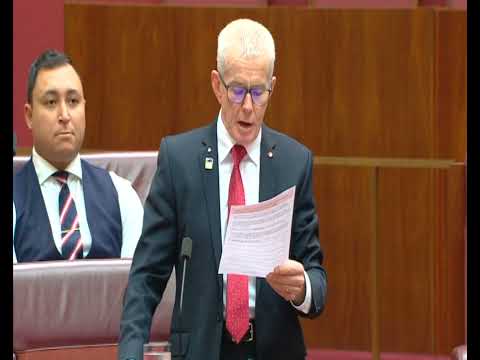

At the recent Senate Estimates, I inquired about the recent turmoil at the Northern Australian Aboriginal Justice Authority (NAAJA), which has seen six CEOs appointed over a two-year period. One of the CEOs was found by the Federal Court to have been unfairly dismissed and chronic staff shortages have led to the suspension of legal representation, leaving approximately 75 Aboriginal individuals unrepresented in court. I questioned how someone with a history of domestic violence could be appointed Chairman of the Board and still remain a Director of the agency. The answer – this individual was elected by the other Directors.
Currently, a grant controller has been appointed to oversee the funds being given to the NAAJA to ensure they are spent appropriately. The grant controller is part of an external firm, adding another layer of bureaucracy to prevent misuse. Refunds of unspent funds are under review and an audit decision is expected by late November. A new Annual General Meeting (AGM) is scheduled for later this year. I asked why the government opposes full audits. Senator McCarthy denied any misuse of funds, though community members claim that money is not reaching the grassroots level. Performance audits will be provided to me on notice.
Transcript
Senator ROBERTS: Thank you for appearing. I have questions on the North Australian Aboriginal Justice Agency. Does someone need to come up for that?
Ms Broun: Senator, we have got NIAA and Attorney-General’s Department.
Senator ROBERTS: I don’t know who to address this to.
Ms Broun: This is Attorney-General’s.
Senator ROBERTS: Thank you. I’m told the North Australian Aboriginal Justice Agency, the Northern Territory’s largest Aboriginal legal service, has been in turmoil in recent years. Since late 2022 there have been six CEOs appointed to the North Australian Aboriginal Justice Agency. That’s in just two years. Its long-standing CEO, Ms Priscilla Atkins, was controversially sacked in February 2023, and she was found in June 2024 by the federal court to have been unfairly dismissed. The agency has suffered a chronic shortage of lawyers and other staff, leading to a suspension of the provision of legal services and almost 75 Aboriginal clients not being represented in court during the staff shortage. They are the figures I have. Minister, is Mr Hugh Woodbury, former CEO and domestic violence perpetrator, still a director of the board of the North Australian Aboriginal Justice Agency?
Senator McCarthy: Yes, he is. We were asked these questions earlier today—just to let you know.
Senator ROBERTS: How is this man able to be appointed the CEO with such a history, given the prevalence of domestic violence as an issue within the Aboriginal community? We’ve seen Senator Cox and Senator Nampijinpa Price both raising this issue.
Mr Worth: Senator, it is for the membership of NAAJA to appoint board members under their constitution. They are an ASIC organisation registered with the ACNC. The appointment of Mr Woodbury to chair that board was made by the board without the knowledge or permission sought by the NIAA. Subsequent to that, Mr Woodbury has resigned as chairman of the board. He remains as a director of NAAJA as is allowed under the terms of the regulator for that organisation, being the ACNC, under the terms of the Commonwealth’s funding agreement. Given that Mr Woodbury is not directly involved in the management or service delivery in his capacity as a non-executive director, consent from NAAJA is not required from the Commonwealth for him to hold that position.
Senator ROBERTS: Minister, it seems pretty unusual for us to be asking the taxpayers of Australia to be giving money to such an entity. What is the state of Commonwealth funding to the agency? There’s been talk of refunds, stopping money, audit and misspent money.
Mr Worth: Since December last year the NIAA has had in place a grant controller managing the funding provided by the NIAA to NAAJA. Under the scope of that arrangement the grant controller reviews the expenditure from NAAJA in relation to those funded programs. When they are satisfied that sufficient evidence has been provided, they release funds to NAAJA. So it’s tightly controlled. All of the standard performance management and performance reporting requirements that exist within our contracts continue. So, again, they need to be meeting both the performance standards and requirements of the contract as well as having the additional scrutiny provided by the grant controller to ensure that there’s clear alignment between the expenditure and the funds that have been provided.
Senator ROBERTS: I missed the earlier part of your answer; I was looking down here. Where does the grant controller, the grant manager, fit in the scheme of things, in the hierarchy?
Mr Worth: The grant controller is an external firm that’s been appointed to manage those funds. They act on behalf of the NIAA, but they are an independent body and they effectively sit in between the NIAA and NAAJA, as I said before, to ensure that NAAJA is applying the funds appropriately in line with the contract.
Senator ROBERTS: So we’ve got the taxpayer giving money to the government, giving money to the NIAA, giving money to the grant controller—the grant manager—who then authorises the money to go to NAAJA.
Mr Worth: To be released—effectively the grant controller acts as a trustee of sorts in terms of just holding and releasing the funds once the evidence has been provided.
Senator ROBERTS: There are a lot of people in the chain. Is the Commonwealth funding of $80 million over five years ending in 2025 still the plan, or is this sum being reviewed?
Ms Harvey: The Attorney-General’s Department is responsible for legal assistance funding. Through the National Legal Assistance Partnership, which is in place from July 2020 until the end of June 2025, we provide funding through to the Northern Territory government that then provides funding through to NAAJA as well as its legal aid commission and other bodies. So that funding is in place until the end of June next year.
Senator ROBERTS: Has this sum been reviewed? It is still in place, but what about the future?
Ms Harvey: Has the funding been reviewed?
Senator ROBERTS: Yes.
Ms Harvey: There has been a broad review of the National Legal Assistance Partnership which was handed down earlier this year, but in terms of the funding to the Northern Territory there are conditions within the National Legal Assistance Partnership that they meet those milestone events and we release the funding to the Northern Territory. They then separately have a contract with NAAJA, for example, which have their own conditions in there.
Senator ROBERTS: Is the Commonwealth still seeking a reimbursement of some unspent funds, as I have been led to believe?
Ms Harvey: The Northern Territory, I think, has been in contact with NAAJA and are working that through, in terms of their unspent funds.
Senator ROBERTS: They’re what?
Ms Harvey: The funding for legal assistance goes through the Northern Territory government, so they have the relationship with NAAJA about that funding including any underspends that there might be.
Senator ROBERTS: What’s the amount being sought? Does anyone know?
Ms Bogart: Being sought in underspends?
Senator ROBERTS: Unspent money back.
Ms Bogart: The Northern Territory government is responsible for that under their grant agreement, and they’re working that through with NAAJA. I think they’re in a negotiation about what that amount looks like.
Senator ROBERTS: So that’s been given to the Northern Territory government, another entity in the chain, and that’s been given to NAAJA, and NAAJA and the Northern Territory government are now haggling over the unspent money. Is that right?
Ms Bogart: They’re working through the amount and what, if any, can be retrieved back by the Northern Territory government.
Senator ROBERTS: Minister, what has been the outcome of audits of the agency?
CHAIR: I’ll need to rotate the call, Senator Roberts.
Senator McCarthy: I’ll refer to Mr Worth.
Mr Worth: The audit is currently being finalised, so at this stage there is no outcome. We’re looking to have it finalised by the end of the year.
Senator ROBERTS: Can you tell me about the nature of the audits: the scope, the purpose, the deadlines?
Mr Worth: The scope itself, yes. The auditor is reviewing expenditure for the 2022-23 financial year, both the application of funds received for the 2022-23 financial year through the national legal services funding as provided by the Northern Territory government as well as the NIAA funding.
Senator ROBERTS: Was that after Ms Priscilla Atkins was controversially sacked?
Mr Worth: Correct.
Senator ROBERTS: Thank you.
CHAIR: Senator Roberts.
*BREAK*
Senator ROBERTS: Back to the NAAJA, the North Australian Aboriginal Justice Agency—I don’t know how you get your head around all these acronyms!—specifically, what is the nature of the current governance of the agency?
Mr Worth: Are you seeking the current status of NAAJA’s governance?
Senator ROBERTS: Governance, yes.
Mr Worth: We are in regular contact with NAAJA. We have received advice from them that they are looking to hold an annual general meeting later this month, on 27 November, in order to elect new board members.
Ms Bellenger: But they are registered with ASIC, and ACNC is their regulation body.
Senator ROBERTS: Who are the voters?
Mr Worth: The members of NAAJA.
Ms Bellenger: The members.
Senator ROBERTS: Is service delivery meeting the needs of the community? As I understand it, it’s suspended at the moment. And is legal representation in court meeting the needs of accused people and in accord with the contract with the Commonwealth Attorney-General?
Ms Harvey: Throughout the time that we have been working with NAAJA coming out of the kinds of issues that they have been having for nearly two years, service delivery has been a really key focus of ours and so we have tracked it really carefully. We understand NAAJA is now back at full service delivery. For example, I mentioned we were advised by NAAJA in October this year that there are no Aboriginal people going unrepresented in criminal proceedings in the Northern Territory except by choice. I think that is a very strong indication of the service delivery having resumed.
Senator ROBERTS: So there was a suspension of the services and they have been resumed?
Ms Harvey: Yes. Toward November last year, I think, there was a temporary suspension of some services. They rebuilt through the end of last year and over the start of this year, and I think it was maybe April—
Ms Bogart: First of April.
Ms Harvey: First of April this year they recommenced full service delivery.
Senator ROBERTS: How long were they suspended? Six months? Twelve months?
Ms Bogart: November to April, so about six months.
Senator ROBERTS: Six months, right. Minister, community members in Queensland tell me that taxpayer funds are not reaching the communities. That’s in the Torres Strait, that’s in Cape York, that’s in southern Queensland. Why does the government oppose full audits of Aboriginal agencies and why, in essence, does the government keep feeding the white and black Aboriginal industry of activists, consultants, academics, lawyers, bureaucrats, politicians and others who are effectively barons while ignoring the plight of Aboriginal people in communities who are not getting what they are entitled to? They’re not getting the support they deserve and need.
Senator McCarthy: Thank you, Senator Roberts. If I could just ask for a breakdown of the particular agencies or departments that they’re not receiving, because there are health departments going out, there are educational departments going out—
Senator ROBERTS: They’re saying in general.
Senator McCarthy: Well, they’re taxpayer funds.
Senator ROBERTS: The money is being hived off to the barons in the white and black Aboriginal industry.
Senator McCarthy: Alright. If you’d like to give us examples that you have specifically, Senator Roberts, but I do know that taxpayer funding goes right across Queensland—federal government funds as well as state funds.
Senator ROBERTS: So why won’t you do audits?
Senator McCarthy: There are audits. The ANAO does its audits with respective organisations, certainly with the land councils that you’re referring to. Questions around audits for land councils actually do occur.
Senator ROBERTS: My understanding, Minister, is that the ANAO does not do audits. It does scoping assessments, not comprehensive audits. They identify areas of weakness, but they do not do comprehensive audits.
Senator McCarthy: That is not correct, Senator Roberts, but perhaps I need to refer to those who work in the area. Mr Worth?
Mr Worth: The ANAO undertakes two kinds of audits on Commonwealth entities. The first ones are financial statement audits, which might be pointing towards the ones you’re talking about with how funds are received and applied through the departments—or agencies, I should call them. The second ones are the performance audits, which are the ones that look at how effective operations, governance arrangements and things like that are and make the recommendations on their findings on those. So there are the two different types of audit.
Senator ROBERTS: Can I have a list on notice, please, of the Aboriginal and Torres Strait Islander agencies that have been audited in the last five years?
Mr Worth: Absolutely.
Senator ROBERTS: The agency, the scope of the audit and the date.
Senator McCarthy: Absolutely.
Senator ROBERTS: Thank you.